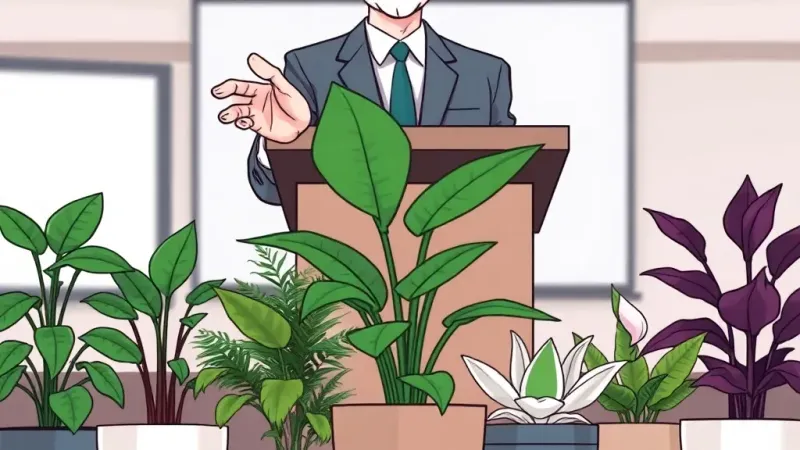
WILMINGTON, DE — In a lecture that attendees described as "surprisingly unsettling," former Delaware State Botanist Dr. Bill McAvoy presented findings yesterday indicating that the collective consciousness of the plant kingdom views human political discourse with a profound and "utterly exhausting" detachment, primarily due to its lack of efficient carbon cycling and the consistent misallocation of chlorophyll. The implications, according to McAvoy, suggest that plant life has essentially "tuned out" humanity's attempts at governance, prioritizing far more fundamental biological imperatives.
Speaking to a packed auditorium at the Dogwood Botanical Gardens during his "FLORA: An Evening with Bill McAvoy" series, Dr. McAvoy unveiled what he termed "The Great Botanical Disconnect." His research, spanning three decades and involving complex bio-electrical field analyses and advanced chlorophyll fluorescence pattern mapping, revealed consistent signs of what could only be interpreted as botanical indifference. "Plants, for example, have perfected resource allocation over hundreds of millions of years," stated Dr. McAvoy, displaying a chart depicting optimal nutrient sharing in a Ponderosa pine. "They communicate, share resources, and adapt to changing environments without a single filibuster, a 'culture war' over soil pH, or a multi-million dollar ad campaign demonizing mycorrhizal fungi. Their primary concern is photosynthesis and robust root networks; ours seems to be... performative outrage and the maintenance of artificial market bubbles."
The botanist's findings further suggested that older, more established plant life, particularly ancient trees with deep root systems, have developed a form of collective despondency regarding humanity’s persistent inability to grasp basic ecological principles. "We observed a consistent decline in localized auxin production—a crucial growth hormone—in species like the coastal redwoods directly correlating with national election cycles," explained Dr. McAvoy, his voice unwavering. "It's as if their cellular machinery just decides, 'You know what? Not today. Let's just focus on converting sunlight into sugar and silently judging the mammals.'" He noted that even typically aggressive invasive species, such as Kudzu, showed a temporary reduction in competitive vigor when exposed to extended loops of 24/7 cable news sound bites regarding congressional budget negotiations.
While the botanical community grapples with the implications, official responses from political circles have been conspicuously absent. An anonymous congressional aide, speaking on background, dismissed the findings: "Our constituents tend to care more about the price of gas and whether their TikTok goes viral than the emotional well-being of a fern or, frankly, the existential ennui of a sequoia." However, a niche speculative futures market on 'Botanical-Political Sentiment' has reportedly opened on a dark web forum, with 'Maple Tree Optimism' trading at an all-time low and 'Weeping Willow Despair' reaching unprecedented highs. Dr. McAvoy concluded his lecture by emphasizing that the plant kingdom’s only discernible 'political agenda' appeared to be the quiet, inexorable process of carbon sequestration and mutual thriving, a goal it has pursued with unwavering dedication for eons, irrespective of human bipartisan gridlock or the latest influencer scandal.
He then advised attendees to hug a tree, "not for the tree's benefit, but because it might just be the most sensible entity you interact with all week, and it won't ask you for money or your opinion on NFTs."