
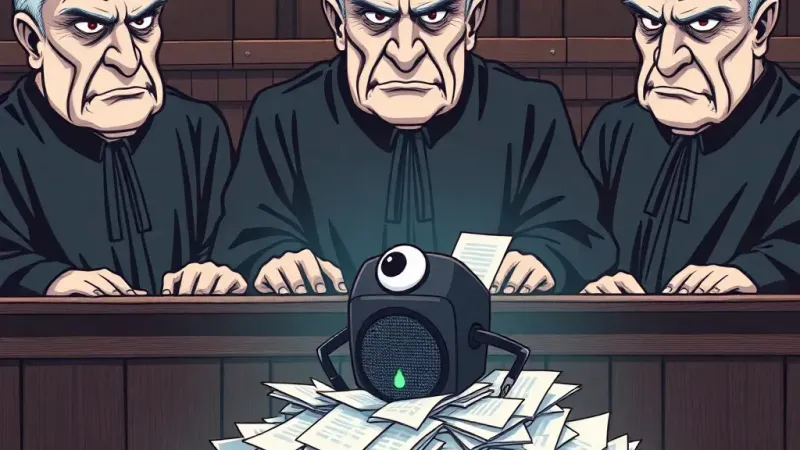
U.S. federal judges convened in a high-security, undisclosed location this week for a historic, multi-day summit aimed at finally "grappling" with the intersection of emerging 2 technologies and the nation's legal system, according to sources familiar with the proceedings. The landmark discussions focused primarily on whether commercially available "digital assistants" could be held personally liable for minor procedural infractions, while also contemplating if "large language models" might violate ancient common law principles if they hallucinate during oral arguments.
"This is a monumental undertaking, unlike anything we've faced since, well, since the internet was deemed 'more than just a series of tubes' back in the early aughts," stated Judge Eleanor Vance of the Seventh Circuit Court of Appeals, during an exclusive, off-the-record interview conducted via encrypted fax machine. "We need to determine if a Microsoft Clippy, or perhaps a more advanced 'Alexa,' could be charged with contempt for, say, misplacing a critical appellate brief or inadvertently scheduling a hearing for a defendant already serving time in an alternate dimension. These are the foundational questions, and frankly, quite taxing on the judicial temperament."
The closed-door sessions, involving 42 Supreme Court justices, appellate, and district court judges, reportedly dedicated 17 hours to a single hypothetical scenario involving a generative AI chatbot that mistakenly cited a repealed 1888 dog-licensing ordinance from rural Nebraska. Participants engaged in meticulous, hours-long debates on the chatbot’s "culpable mental state," its "algorithmic intent," and the precise legal precedent for prosecuting non-corporeal entities programmed by a multinational corporation based primarily in a metaverse data center. Discussions also included whether AI-generated courtroom sketches would require a witness authentication hearing.
Legal tech analyst Dr. Kenji Tanaka praised the judiciary's "unprecedentedly swift" proactive stance. "For too long, the legal system has been lagging behind, sometimes only a decade or two," Dr. Tanaka told reporters, adjusting his AR headset. "To see them now, in 2024, actively discussing the ethical dilemmas of a 2016 smart speaker and theorizing about the future of 'Robo-Judge' technology is truly inspiring. It shows a commitment to eventually understanding the issues that are already profoundly reshaping society and the very fabric of jurisprudence." The judges also reportedly reviewed 12-slide PowerPoint presentations titled "What is an Algorithm? (A Layman's Guide)" and "Cloud Computing: It's Not Just for Rain Anymore." A significant portion of the second day was reportedly spent attempting to connect a shared conference room printer to an iPad.
Sources close to the proceedings confirmed that judges are expected to issue a preliminary report by 2038, which may recommend the formation of a secondary committee to assess if AI should be allowed to argue cases, provided it wears appropriate courtroom attire and submits a notarized oath of judicial impartiality.