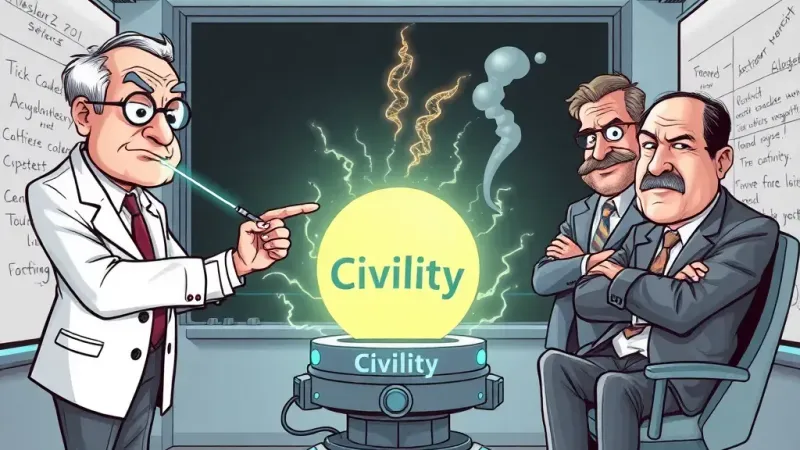
WASHINGTON D.C. – A multi-day summit of leading academics, policy advocates, and think tank representatives, broadcast live on C-SPAN, has initiated a comprehensive exploration into a radical and largely undeveloped concept known as “civility.” The unprecedented gathering sought to define, understand, and perhaps even reintroduce what many experts now believe could be a foundational element for improved interpersonal and political interactions.
The unprecedented event, titled “Deconstructing Decency: Pathways to Polite Discourse,” convened at the Peterson Center for Policy Performance and featured extensive discussion on the theoretical underpinnings of individuals treating each other with basic respect. Panelists presented white papers on “Non-Aggressive Communication Modalities” and “The Efficacy of Listening,” suggesting preliminary data indicated a potential correlation between a reduction in overt hostility and a measurable decrease in societal tension.
“For years, we’ve operated under the assumption that an adversarial posture was the default, even optimal, setting for public life,” stated Dr. Evelyn Thorne, a behavioral ethicist and lead researcher for the newly formed Institute for Basic Human Decorum. “What our early findings suggest is that—and this is groundbreaking—people might actually respond more favorably when not subjected to relentless personal attacks or bad-faith misrepresentations. It’s early days, but the implications are vast.” Dr. Thorne noted that her team is currently developing a proprietary Civility Quotient (CQ) metric to quantify baseline levels of rudeness across various societal sectors.
The panel also grappled with the logistical challenges of implementing such a novel approach. Discussions included potential pilot programs for “non-shouting zones” in public forums, federal grants for “agreeable interaction facilitation,” and the introduction of “politeness nudges” in online comment sections. One particularly lively segment focused on whether civility, if successfully reintegrated, might disrupt existing political and media business models that thrive on division.
“We’re looking at what is essentially uncharted territory,” explained Rex Holloway, a senior fellow at the Center for Public Engagement Optimization, during a segment on the economic impacts of widespread courtesy. “If people stop watching every screaming match or outrage cycle, where does that leave the digital 2? It’s a complex ecosystem. We need robust, longitudinal studies to understand the full market implications of everyone just… being nice.”
The summit concluded with a unanimous call for increased funding and further research into the practical applications of this groundbreaking “civility” concept, with several panelists expressing optimism that future generations might one day understand its true potential. A follow-up symposium is tentatively scheduled for late 2026, pending an exhaustive literature review of documented instances of basic human courtesy throughout history.