
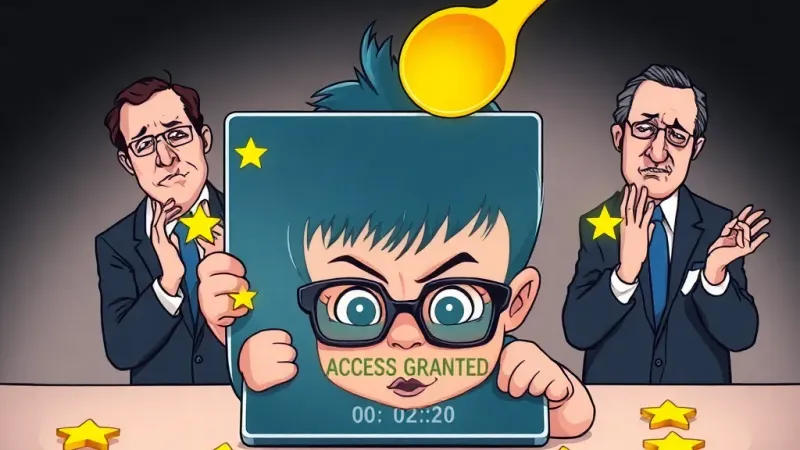
BRUSSELS — The European Union’s ambitious new age verification application, designed to safeguard children from inappropriate online content and protect user privacy across all 27 member states, was comprehensively breached within two minutes of its public unveiling. Independent security researchers confirmed Tuesday that the "EU: Verify" system, touted by officials as a "gold standard" for digital identity, not only failed to verify age reliably but also inadvertently exposed a treasure trove of personal data to anyone with basic hacking tools and a mild curiosity.
"We literally just typed '18' into the age field and then, out of sheer habit, typed 'SELECT * FROM users;' into another field that was clearly labeled 'Developer Debug Console - DO NOT TYPE SQL COMMANDS HERE'," explained Dr. Anya Sharma, lead researcher at Cyber-Knut, a prominent Belgian digital ethics think tank. "The app immediately returned a list of 4.7 million EU citizens, including their birthdays, home addresses, blood types, and their preferred brand of artisanal cheese. Frankly, we were trying to be more subtle, perhaps exploit a buffer overflow, but the system practically handed us the encryption keys on a silver platter with a complementary EU flag enamel pin."
EU officials, while acknowledging the "immediate and thorough feedback from our dedicated security community," maintained a stance of cautious optimism during an emergency press conference. "This rapid penetration demonstrates the resilience of our proactive vulnerability detection framework," stated Commissioner Jean-Pierre Dubois, head of the Directorate-General for Digital Standards and Incompetence, adjusting his tie with visible effort. "We always intended for external experts to stress-test the system. To have it stress-tested before the press conference even concluded is, shall we say, a testament to the community's unparalleled engagement with our mission. We're calling this an 'inadvertent pre-release public beta phase' that has provided invaluable insights."
The compromised data, which reportedly includes the full biometric scans of 1.2 million citizens who enthusiastically volunteered for a pilot program in exchange for a €5 digital voucher, is now widely accessible across various dark web forums. Reports indicate the data is often bundled with complimentary discount codes for online gambling sites and "exclusive access" to what appears to be a decade-old torrent of Eurodance music. Critics are now questioning the €34 million development budget and the year-long consultation process that involved 17 different regulatory bodies and 45 distinct subcommittees, none of whom, it appears, thought to run a simple SQL injection test or, as Dr. Sharma put it, "ask a moderately tech-savvy teenager for their opinion."
In a related development, a spokesperson for the app's primary contractor, 'SecureDataSolutions AG,' a subsidiary of 'Globex Corp.' known for its innovative "firewall made of hopes and dreams" technology, announced a new product line focusing on "post-breach data reclamation services" and "identity theft mitigation seminars," now available at a significant premium to all affected EU citizens. The company reiterated its commitment to data security, promising that future apps would include a CAPTCHA.
The incident has reignited debates about governmental digital infrastructure spending and the persistent gap between bureaucratic ambition and technical reality. One particularly frustrated user, Mr. Bjorn Svensson from Stockholm, whose entire medical history including a minor fungal infection was exposed, simply remarked, "I just wanted to watch a video about knitting. Now I'm apparently also interested in betting on greyhounds and receiving targeted ads for anti-fungal cream."
"We're not saying it was *designed* to be the most efficient data harvesting tool ever built," Dr. Sharma later mused, "but if it was, they absolutely nailed the brief."