
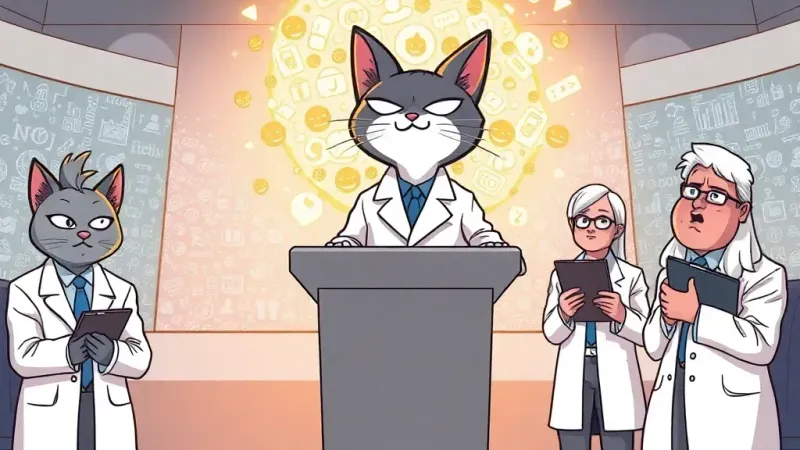
Los Angeles, CA – In a move being described by digital ethnographers as “remarkably insightful,” Grammy-winning artist Doja Cat has recently confirmed that the internet contains users with opinions, some of which are critical. Her groundbreaking TikTok video, where she expressed being “tickled” and “bothered” by online commentary regarding fellow pop icon Madonna's age, is now considered a foundational text for understanding contemporary digital discourse. Experts suggest this celebrity-validated observation could shift paradigms in how online interactions are perceived by the general public, particularly those who have not personally experienced the internet.
"For years, researchers have grappled with the nebulous concept of an 'online opinion'," stated Dr. Evelyn Thorne, head of the Institute for Digital Ephemera and Human Behavior at the University of Southern California. "Doja Cat's candid articulation provides us with tangible, quantifiable evidence that individuals, once connected to a global network, frequently choose to share their perspectives, sometimes unsolicited. This is not just a cultural moment; it’s a robust data point validating decades of anecdotal evidence." Dr. Thorne noted that previous studies often relied on less definitive sources, such as comments sections or 2 feeds, which lacked the crucial celebrity endorsement.
The revelation has sent ripples through the online commentary industry, with many pundits scrambling to re-evaluate their analytical frameworks. "We always suspected there were people out there, behind keyboards, typing things," admitted Skip Harrison, a veteran online discourse analyst for 'NetNarrative Today.' "But to have a major artist, someone of Doja Cat's stature, confirm this phenomenon so explicitly – it changes everything. It's like Copernicus, but for Twitter." Harrison speculates that this newfound understanding could lead to entirely new sub-fields of study, such as 'Opinion Ecology' and 'The Taxonomy of Unsolicited Feedback.'
While some cynics have pointed out that the internet's capacity for diverse, often negative, commentary has been widely observed since its inception, their claims are being dismissed as pre-Doja Cat thinking. "Those perspectives simply didn't have the celebrity-backed evidentiary weight," explained a spokesperson for the Global Institute for Validated Digital Phenomena. "Now, thanks to Ms. Cat, we can definitively say: yes, people have thoughts, and some of those thoughts are about other people. And they put them on the internet. It's truly monumental."
The academic community anticipates a surge in research grants for projects exploring the profound implications of this discovery, particularly how this information might be disseminated to audiences who continue to believe the internet is primarily for cat videos and finding directions. The institute also confirmed that, astonishingly, some of these opinions are not always positive.