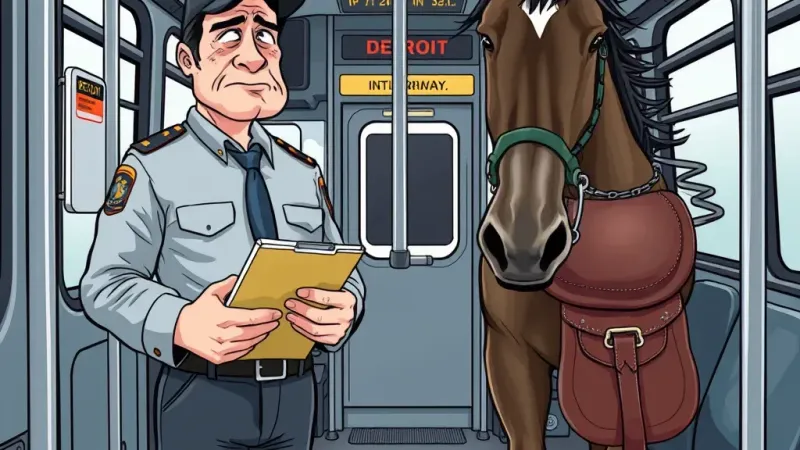
DETROIT—Following an incident in which two horses successfully boarded a municipal transit vehicle to highlight the rich and underrepresented heritage of urban cowboy culture, the Detroit Department of Transportation announced Wednesday that all route operators will undergo intensive retraining on how to properly process equine commuters.
The mandatory retraining program, developed over a grueling forty-eight-hour panic in city hall, aims to correct what administrators are calling a catastrophic failure of passenger hospitality. Rather than addressing why a multi-ton farm animal bypassed the fare box, municipal leadership has focused entirely on the driver's failure to offer adequate stabling advice and pasture recommendations.
"Our operators are trained to handle complex urban transit scenarios, including delayed arrivals, fare disputes, and individuals screaming about the end times," said transit authority spokesperson Marcus Vance, speaking directly past the glaring operational reality that city buses are structurally unequipped for livestock. "What they were apparently not prepared for was the majestic presence of equestrian culture entering through the front doors without exact change. That training gap stops today."
The new curriculum, titled 'Transit Equity and Livestock Integration,' will require every driver to spend sixteen hours in a simulated paddock environment learning to distinguish between standard commuters and thoroughbreds attempting to commute to the nearest open pasture. Drivers will also be instructed on how to properly validate transit cards using a horse's teeth, how to politely request that larger animals fold themselves into the wheelchair securement area, and how to issue transfer slips to beasts of burden without startling them into a panic that could shatter the vehicle's remaining fiberglass windows.
City officials stressed that the retraining is not a punishment, but rather an exciting opportunity for municipal workers to expand their skill sets into veterinary logistics. The city council has already allocated an emergency budget of four hundred thousand dollars to install temporary hay racks at major downtown transit hubs, alongside industrial-sized manure scoops that will be bolted to the back of every vehicle in the fleet.
Critics of the transit system have pointed out that the city's buses are consistently thirty minutes late, frequently catch fire on the freeway, and lack basic heating during Michigan winters, making the sudden pivot to equine accommodation priorities feel slightly misplaced. Municipal leadership dismissed these concerns as anti-cowboy bigotry.
"People love to complain about the buses until a majestic stallion steps onto the vehicle to make a poignant sociological statement about representation in urban spaces," Vance added, completely ignoring the fact that the bus was reportedly three hours behind schedule before the horses even arrived. "If you want a reliable transit system, buy a horse. If you want a mobile petting zoo that occasionally hits potholes on Woodward Avenue, ride the bus."
The transit union has responded by filing a federal grievance, arguing that managing livestock falls well outside the job description of driving a diesel-powered tin can through the inner city. Union representatives noted that the collective bargaining agreement explicitly protects drivers from having to clean up after passengers who weigh over a thousand pounds and refuse to use the pull-cord to signal their stop.
Despite the pushback, the city remains steadfast. Officials confirmed that additional modules are already in development for next month, focusing specifically on how to handle emotional support longhorns, transit-eligible ostriches, and rogue agricultural exhibits seeking reliable cross-town transportation.