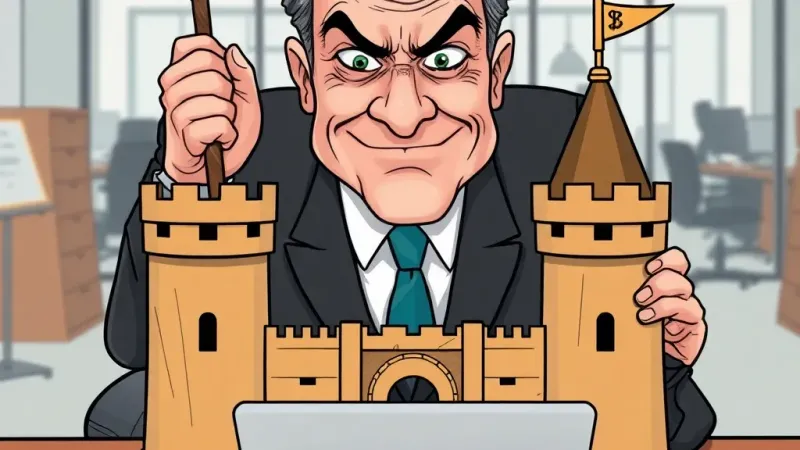
NEW YORK, NY – The once-humble wooden pop-up castle, traditionally relegated to children's playrooms, is experiencing an unprecedented resurgence as an essential "analogue mindfulness tool" and "strategic desk accoutrement" for the modern workforce. What was once a simple toy is now being lauded by productivity gurus and wellness coaches alike as a critical component for focused, high-performing executives.
Market analysts at the Global Tactile Engagement Consortium (GTEC) report a 340% increase in sales of premium, artisanal desk castles over the last fiscal quarter. "This isn't just nostalgia; it's neuro-rehabilitation," stated Dr. Evelyn Thorne, Chair of Adult Play Theory at the Guild Institute of Applied Nostalgia. "We've observed a profound psychological shift. The desk castle isn't just decor; it's a silent protest against digital overload, a tangible anchor in the maelstrom of modern capitalism. It reminds us that once, we built worlds, not just spreadsheets."
Companies are actively integrating these miniature fortresses into their office 2, with some forward-thinking firms providing "castle breaks" where employees are encouraged to "re-engage with spatial reasoning and imaginative conquest" for up to five minutes per hour. Marvin Finch, CEO of 'Executive Escapism,' a luxury pop-up fort consultancy, notes, "Our clients are reporting a 17% increase in 'imaginative problem-solving' after just two weeks of regular castle interaction. It's about re-engaging the pre-frontal cortex with pre-fabricated whimsy. Why meditate when you can defend a tiny moat from an invisible, existential threat?"
The educational aspect, once aimed at developing motor skills in toddlers, has been meticulously re-contextualized for adult professional development. Workshops titled "Strategic Siege & Summit: Unlocking Your Inner Monarch" are now commonplace, teaching executives how the principles of castle defense can be directly applied to market share protection and hostile takeover bids. One participant, financial analyst Brenda Chen, remarked, "Before my desk castle, I just felt like a cog. Now, I feel like a well-fortified cog, impenetrable and strategically positioned. It’s a total game-changer for my LinkedIn profile and my overall personal brand narrative."
This boom has led to a seismic shift in the toy manufacturing industry, with several traditional children's toy brands hastily re-branding their offerings as "Tactical Executive Terrain Models" and "Wellness Fortification Units." The surge in demand for "heirloom-quality" models, crafted from ethically sourced, artisanal lumber, has pushed prices upwards of $400, sparking concerns that the psychological benefits of analogue escapism are becoming exclusive to the upper echelons of corporate power. "We’re seeing a clear bifurcation," explained market strategist Lance Sterling. "The mass-produced plastic castles are now for actual children, while the premium wooden ones are reserved for the 1% who truly need to de-stress from managing the 99%."
Children, once the primary beneficiaries of these whimsical structures, are reportedly showing confusion when told their wooden playsets are now "critical assets for adult emotional regulation and strategic visualization." Many have been observed attempting to reclaim their castles, only to be met with explanations about "return on investment" and "optimal brain-state calibration."
Industry experts now predict a black market for genuine, un-mindfulness-trained wooden knights, possibly operated by disillusioned eight-year-olds.