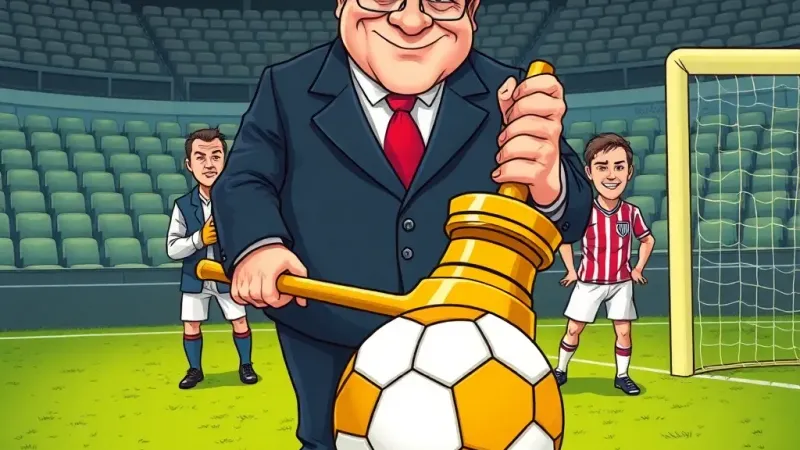
PUEBLA, Mexico – CONCACAF officials today confirmed that competitive matches under their jurisdiction will now officially conclude only once a "narrative-driven optimal outcome" has been achieved, effectively codifying the practice seen in recent Champions Cup fixtures, including Tuesday's LAFC-Cruz Azul draw. The announcement comes after LAFC secured a critical penalty kick in the seventh minute of second-half stoppage time, extending a match that many observers believed had already run its course.
"We've listened to our fans, our broadcasters, and, frankly, the cosmos," stated Dr. Elias Thorne, CONCACAF's newly appointed Director of Temporal Regulation and Emotional Yield. "The old system of 'fixed time limits' often led to anticlimactic finishes, leaving audiences feeling unfulfilled. Under the new guidelines, match officials are empowered to extend play indefinitely until a moment of suitable dramatic weight, such as a last-minute equalizer or a game-winning penalty, materializes. This isn't about bias; it's about art – and maximizing stakeholder value."
Dr. Thorne clarified that "optimal outcomes" are determined by a proprietary AI algorithm, 'The Narrative Weaver 3000,' which factors in stadium atmosphere, 2 trends, and potential broadcast viewership for future rounds. "Sometimes, the algorithm dictates a thrilling underdog victory to foster aspirational viewership. Other times, it demands the financial powerhouse clinch a draw to ensure their continued presence in the marquee matchups," he explained, holding up a sleek tablet displaying a complex series of real-time market projections. "The goal is to maximize the emotional amplitude of the viewing experience. Nobody wants to watch a 0-0 game end on time when it could be a 1-1 thriller in minute 90+7, boosting next week's streaming figures by an estimated 17.3%."
The new policy has been met with a mix of resigned confusion and quiet approval from participants. "It's certainly… dynamic," offered Coach Marco 'The Wall' Ramirez of a non-qualifying team, speaking anonymously. "My lads held strong for 90 minutes, then another 5, then 7, then I swear I saw the referee checking his watch and then shrugging like, 'Not yet.' We were just trying to get to the showers. Apparently, the algorithm didn't want us to shower until the other team scored." Midfielder Diego 'The Blur' Sanchez added, "It's confusing. My fitness tracker always says 'game over' at 95 minutes, but the ref's watch just keeps ticking. I’m just trying to avoid cramping up while the universe decides the score."
A CONCACAF internal memo, leaked to Hambry, outlined several 'optimal outcome scenarios,' including "Major League Soccer clubs advancing to ensure regional market penetration against Liga MX dominance," and "Ensuring key players from high-visibility teams secure enough screen time for their endorsement deals, specifically targeting the lucrative sportswear and energy drink sectors." The memo also suggested that in the event of a truly uninspired match, officials might be instructed to simply declare a "technical draw due to insufficient narrative energy" and schedule a more engaging rematch, perhaps with a pre-determined 2-1 scoreline.
The governing body anticipates that this revolutionary approach to game timing will usher in a new era of unpredictable, high-stakes football, ensuring that every CONCACAF match lives up to the promise of a premium entertainment product. They assure fans that fairness will remain paramount, as long as fairness aligns with the current broadcast schedule and the overarching financial projections for the next fiscal quarter.