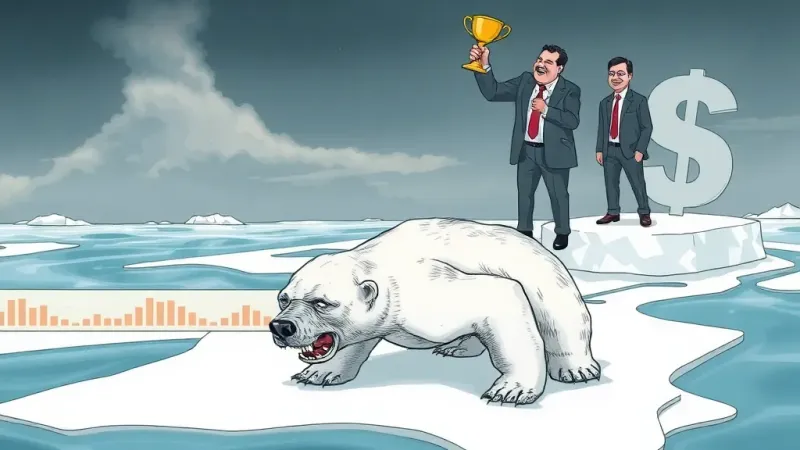
WASHINGTON D.C. – A prominent conservative think tank, the Institute for Market Solutions (IMS), has issued a groundbreaking report reclassifying a polar bear's recent 427-mile swim as a prime example of "ecological self-relocation" and "free market adaptation." The report, released Tuesday, posits that the arduous journey undertaken by the female polar bear, driven by melting sea ice, demonstrates the inherent resilience of species when confronted with environmental shifts, rather than being an indicator of impending climate catastrophe requiring costly intervention.
"This remarkable creature isn't a victim; it's an innovator, a true bootstraps success story," stated Dr. Thaddeus Bering, lead author of the IMS report and a senior fellow specializing in resource reallocation. "For too long, we've viewed these situations through a lens of dependency, demanding handouts and systemic overhauls. What we're witnessing is a robust, self-sufficient mammal leveraging its innate capabilities to optimize its habitat. It's a testament to the fact that when left unregulated, nature finds a way to realign its assets, proving that top-down intervention is often counterproductive to organic survival strategies." Dr. Bering emphasized that such "adaptive maneuvers" are vital for ensuring the long-term viability of the Arctic ecosystem.
The report was immediately lauded by industry leaders, with Arctic drilling firm Borealis Energy Solutions CEO, Reginald P. Fairbanks, calling it "a refreshing perspective that aligns perfectly with our vision." "Our operations, much like this admirable bear's journey, are about embracing new frontiers and maximizing shareholder value," Fairbanks told reporters. "We believe in progress, and sometimes progress means adapting to new geographical realities. Perhaps we can even learn from this bear’s efficiency in resource expenditure – a true masterclass in lean enterprise." Sources close to Fairbanks indicated he is already exploring "Arctic Transit Lanes" to facilitate future "species mobility" initiatives, noting potential for collaboration on infrastructure via a new "Polar Pathways Public-Private Partnership."
While environmental scientists largely condemned the report as a "tone-deaf dismissal of anthropogenic climate change," IMS pushed back, accusing critics of "pessimistic anthropomorphism and an unscientific attachment to historical data." "We prefer to celebrate biological achievement, not lament a temporary logistical challenge," Dr. Bering clarified, responding to accusations that the bear was likely starving and exhausted. "Focusing on temporary discomfort distracts from the profound long-term systemic adjustments occurring across the globe. This polar bear, unlike certain human populations, didn't wait for a government handout; it literally swam for its future, showcasing remarkable self-reliance and grit." The report concluded by suggesting further research into how other species might similarly "pivot" when their traditional ecosystems become "economically unviable."
The IMS plans to nominate the polar bear for their annual "Free Spirit of the Arctic" award, provided it survives to attend the gala ceremony.