
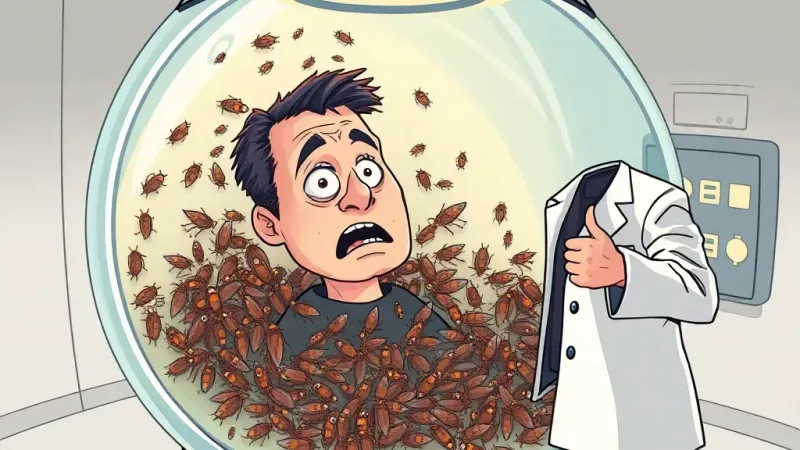
WASHINGTON, D.C. — In a groundbreaking move, the Department of Health and Human Services (HHS) today released new recommendations designating "Cicada Immersion Therapy (CIT)" as an essential mental wellness practice. The guidelines, which come amid the largest dual brood emergence in over two centuries, suggest that prolonged, unmediated exposure to the cacophonous, six-week-long insect phenomenon offers unique therapeutic benefits.
“For too long, we’ve undervalued the profound, albeit temporary, grounding experience that 17-year cicadas offer,” stated Dr. Brenda Carmichael, lead author of the 'National Cicada Response Protocol: Phase IV – Integration and Wellness.' “The collective hum, the cyclical nature, the sheer inevitability of it all—it provides a crucial counterpoint to the relentless 24/7 news cycle and the tyranny of digital notifications. Patients report a remarkable ability to focus solely on the present moment, primarily because it's impossible to hear anything else.”
The recommendations detail various forms of CIT, ranging from 'Passive Auditory Soaking' (simply existing outdoors during peak emergence) to 'Active Encounter & Engagement,' which encourages interaction with the insects through observation, photography, and, for advanced practitioners, taste-testing. The protocol also formally recognizes a burgeoning industry of 'Cicada Doulas' and 'Entomological Life Coaches' who guide individuals through their immersion journey, often incorporating 'ecdysis-inspired interpretive dance' and 'chitin-based spiritual art workshops.'
Financial analysts are already predicting a significant boom in the 'Cicada-adjacent 2,' with specialized gear, educational programs, and even high-end gastronomic experiences emerging. “This isn’t just about bugs; it's about a multi-billion dollar wellness ecosystem,” commented Chad Kensington, a senior market strategist for BlackRock Capital, while adjusting his cicada-themed smart glasses. “We’re seeing a surge in 'brood-specific' tourism packages, artisanal cicada-flour bakeries, and bespoke insect-shedding art installations. The ROI on a 17-year investment cycle is simply unparalleled.”
Critics, primarily entomologists who prefer their research undisturbed by performance art, argue that rebranding a mass insect hatching as 'therapy' is both medically dubious and, frankly, unhygienic. However, HHS insists the benefits outweigh any potential psychological distress induced by hundreds of thousands of flying insects attempting to mate directly above one's head.
Officials concluded by noting that while the current emergence is drawing to a close, they are already planning for the next major brood in 2025, advising citizens to begin preparing their emotional and culinary palates.
Some therapists simply recommend yelling into a pillow, but that option lacks the crucial element of protein.