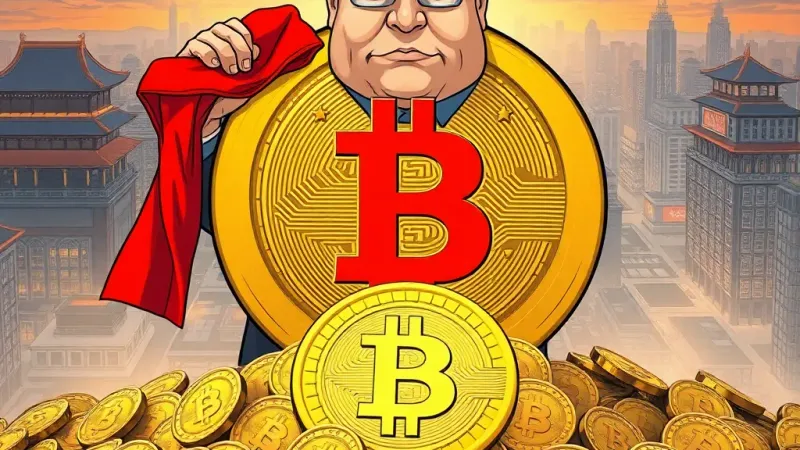
Beijing, PRC – The People’s Republic of China today officially launched its highly anticipated "Digital Incentive Units" (DIUs), the foundational currency of its burgeoning AI-driven "token 2." Officials were quick to clarify that these new digital assets, designed to reward participation in China's vast open-source AI ecosystem and real-world AI applications, bear absolutely no relation to speculative blockchain-based cryptocurrencies, despite sharing a remarkably similar functionality and a propensity for fluctuating value based on supply and demand.
The new DIUs are described by state media as a "sophisticated evolution of value exchange," meticulously designed to fuel innovation within China’s rapidly expanding AI sector. "Unlike the chaotic, unregulated 'tokens' that plague Western markets, our Digital Incentive Units are backed by robust state oversight, cutting-edge proprietary algorithmic valuation matrices, and the tangible progress of our national AI initiatives," explained Dr. Li Wei, head of the National AI Innovation Office, during a press briefing held entirely within a metaverse simulation of the Great Hall of the People. He added that DIUs are exclusively earned through verifiable contributions to designated AI projects, such as training data sets for large language models or developing specific industry applications, ensuring "real-world utility, not speculative gambles."
However, market observers were quick to point out the striking parallels. "It’s a masterclass in semantic re-engineering," noted Professor Anya Sharma, a digital economics specialist at the Beijing School of Advanced Tech Diplomacy. "They’ve essentially reinvented the wheel, but painted it green and called it a 'circular momentum enhancer.' The underlying mechanics of scarcity, fungibility, and exchange — even the potential for significant capital gains — are all there. Calling them 'digital incentives' instead of 'tokens' is like calling a lion a 'striped feline enthusiasm provider' to avoid associating it with aggression." Professor Sharma added that early indications suggest unofficial secondary markets for DIUs are already flourishing on messaging apps, with prices fluctuating wildly based on state media pronouncements and government-issued whitepapers.
Analysts suggest the meticulous rebranding effort is a direct response to the global scrutiny surrounding decentralized digital currencies and, more specifically, a clever sidestep of lingering US export controls. "When you can’t import the high-end GPUs you want, you innovate in the lexicography department," quipped a senior Western diplomat speaking on background. "It’s hard to impose sanctions on something that, by official decree, simply isn't what it very clearly appears to be. They’ve essentially declared their tokens to be Schrödinger's currency: both a token and not a token, depending on which side of the customs border you’re standing." This semantic gymnastics, experts argue, allows Beijing to foster a vibrant digital 2 while maintaining a public distance from the often-maligned crypto space.
Ultimately, officials reiterated that any resemblance between their stable, state-managed Digital Incentive Units and volatile, speculative crypto tokens is purely coincidental, much like the resemblance between a state-controlled economy and a free market.