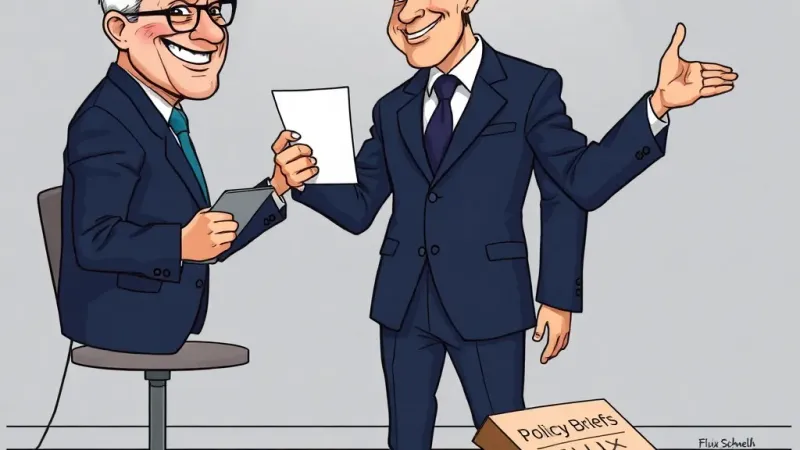
LOS ANGELES – Production on the highly anticipated romantic drama 'Ally Clark' has issued a casting call for the role of 'Senator,' with industry insiders admitting the part primarily requires actors who can project immense confidence while simultaneously conveying a profound, almost studied, lack of understanding regarding the issues at hand. The open call has sparked conversation within the industry about the evolving demands of political roles and the striking overlap with contemporary governance.
“We’re not looking for someone who’s done their research on infrastructure bills or geopolitical tensions,” explained veteran casting director Brenda Kinkaid, whose portfolio includes numerous political biopics and reality TV judges. “Frankly, that would make the performance less authentic. What we really need is someone who can stare blankly at a complex chart, nod sagely, and then pivot to an impassioned, albeit entirely irrelevant, anecdote about their constituent’s dog. It’s a very specific skill set, but surprisingly common among our applicant pool.”
Kinkaid noted that unlike playing a neurosurgeon, which demands memorizing complex medical jargon, or a quantum physicist, which requires some grasp of theoretical frameworks, the role of a senator has become remarkably accessible. “Most of the performance is just maintaining a permanent expression of concerned disapproval, occasionally punctuated by a soundbite-ready outburst that carefully avoids proposing actual solutions. We’ve found that actors with strong improv skills and a knack for selective listening tend to excel.” She added that recent workshops focused heavily on mastering the “thoughtful pause before asking a question that was already answered in the briefing materials.”
Dr. Evelyn Reed, a cultural anthropologist specializing in political theater at the Institute for Public Credulity, weighed in on the phenomenon. “The line between portraying a senator and actually being one has become so blurred that we’re seeing increasing overlap in resumes,” Dr. Reed observed. “Many elected officials are, in essence, just method acting for democracy, fully embodying the character of ‘public servant’ without needing to engage with the finer points of public service. It’s a highly efficient system, dramatically speaking, though perhaps less so for the populace.” The casting call notably excluded any requirement for policy expertise, legislative experience, or even a basic understanding of how a bill becomes a law.