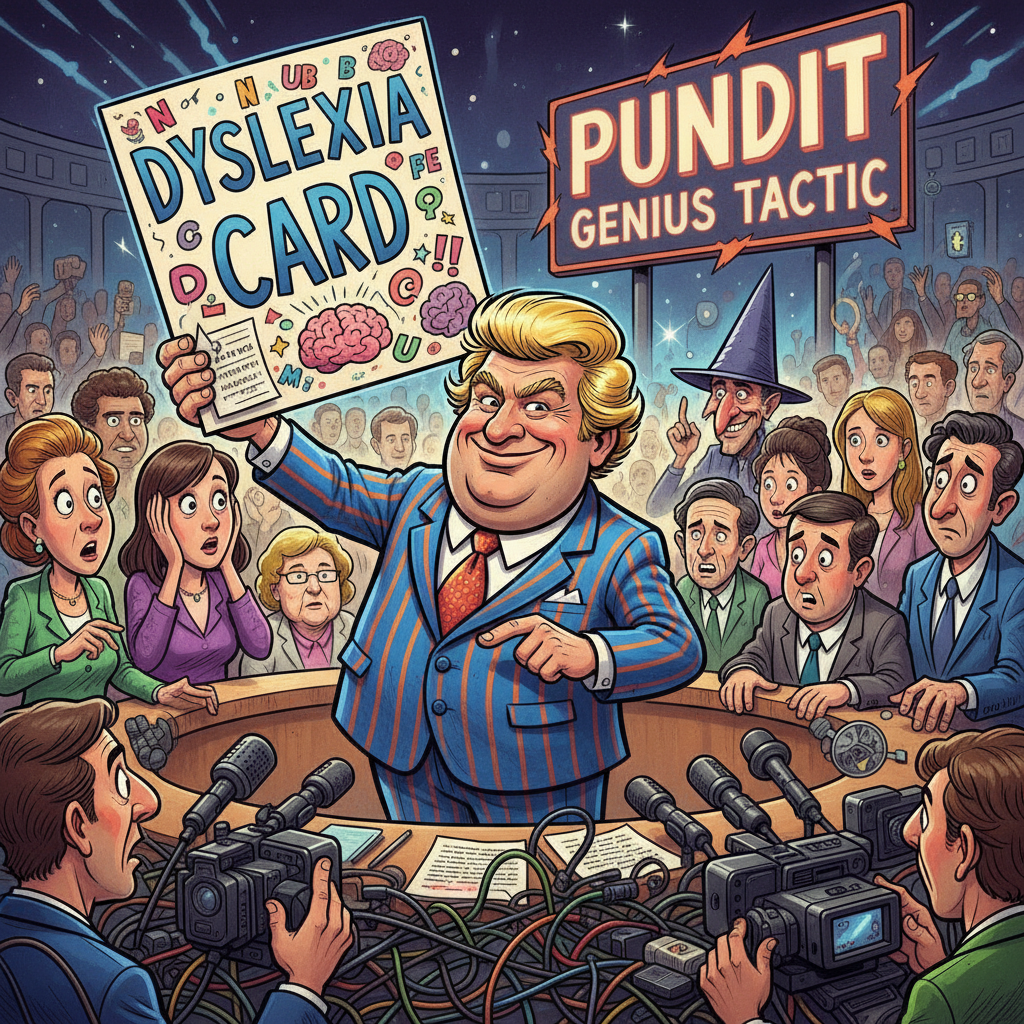
WASHINGTON D.C. — Following recent high-profile exchanges, top political campaign strategists have confirmed that invoking a candidate's learning disability is now a fully sanctioned and strategically viable maneuver in the modern political arena. The move, previously considered off-limits, has been reclassified as a 'powerful emotional appeal' by a bipartisan committee of consultants.
“We’ve seen the data, and frankly, it’s a game-changer,” stated Dr. Evelyn Thorne, head of the Institute for Advanced Political Jujitsu. “Whether it’s used to explain away a verbal gaffe, a policy misstep, or simply to paint an opponent as heartless, the 'dyslexia card' offers unparalleled versatility. It’s the ultimate shield and sword.”
The breakthrough comes after a prominent political spouse publicly chastised a former president for mocking her husband’s dyslexia, sparking a national conversation that, according to Thorne, “clearly demonstrated the public’s readiness to accept this new paradigm.” The former president’s camp, in turn, doubled down, suggesting the governor was simply “dumb,” further solidifying the strategic utility of the disability as a point of contention.
“It’s about framing,” explained veteran campaign manager, Mark 'The Hammer' Harrison. “Before, if your guy stumbled over a word, it was a gaffe. Now, it’s a 'brave struggle against an unseen adversary.' And if the other side points it out? They’re monsters. It’s beautiful.” Harrison noted that campaigns are already researching other potential 'cards' to play, including 'mild astigmatism' and 'occasional hangnail.'
Future debates are expected to feature opening statements that include a brief medical history, ensuring all potential 'cards' are on the table from the outset.