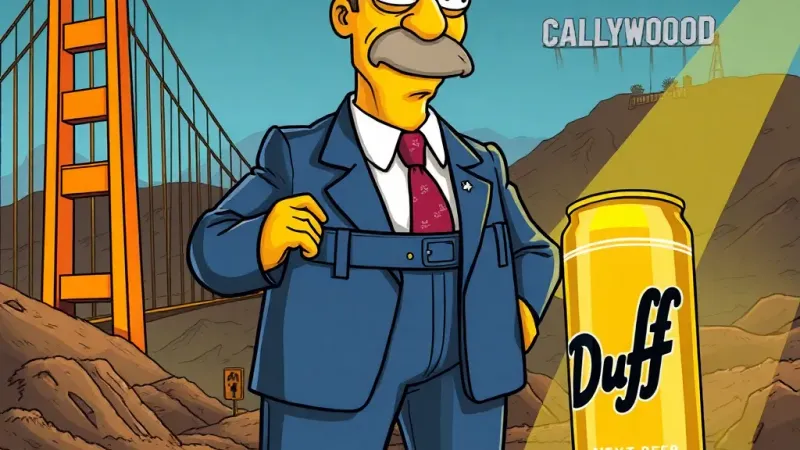
SACRAMENTO, CA — In a move hailed by industry giants and met with raised eyebrows by anyone paying taxes, the California Film Commission has awarded nearly $200 million in tax credits to a sequel for “The Simpsons Movie.” State officials justified the massive allocation by classifying the production of “The Simpsons Movie 2” as an “essential cultural infrastructure project,” crucial for the state’s economic vitality and the American public’s collective spiritual fortitude.
“While some might view a cartoon movie as mere entertainment, we see it as a critical pillar of our societal framework,” stated Brenda Kincaid, Deputy Director of the California Office of Cinematic Fiscal Prudence, during a press briefing held adjacent to a soundstage. “The sustained comedic output from Springfield is not just an economic driver; it provides intangible assets, offering an annual cultural consumption dividend that significantly outweighs its initial public investment. Without this foundational storytelling, where would our shared reality even begin to bend?”
The $199 million tax credit is part of a larger state initiative to retain film production within California, although critics questioned why a globally recognized, multi-billion-dollar franchise from a major studio conglomerate would require such significant public assistance. Dr. Thaddeus Bloom, lead researcher at the Institute for Sustainable Animated Content, countered, arguing the state’s foresight was commendable. “The critical animation pipeline is always vulnerable,” Bloom explained, referencing a proprietary Hambry analysis. “Imagine the ripple effect if 237,000 gigabytes of unique character models and the associated digital assets were forced to relocate due to a minor financial oversight. The subsequent vacuum in cultural meme generation alone could plunge the nation into an existential void. This credit is not just about jobs; it’s about maintaining our collective narrative bandwidth.”
Production sources indicate the funds will be meticulously deployed across various essential departments, including the procurement of 4K render farms capable of accurately depicting Homer’s evolving hairline and ensuring an adequate supply of Duff Beer-branded water for all animators. “We appreciate California’s profound understanding of the unique challenges involved in sustaining a multi-billion dollar intellectual property,” commented Meredith Vance, Head of Strategic IP Monetization at Global Content Conglomerate, without specifying which global content conglomerate she was referring to. “This isn’t about profit; it’s about cultural preservation. And frankly, a few hundred million dollars is a small price to pay for ensuring the next generation understands the profound socio-economic critiques embedded within a Kwik-E-Mart robbery.”
Critics who suggested the money might be better spent on, say, actual infrastructure, homelessness, or public education were reportedly met with a blank stare and a pamphlet titled “The Economic Multiplier Effect of Perpetual Nostalgia.”
California: where the only thing more Golden than the State is the age of its most essential cartoons.