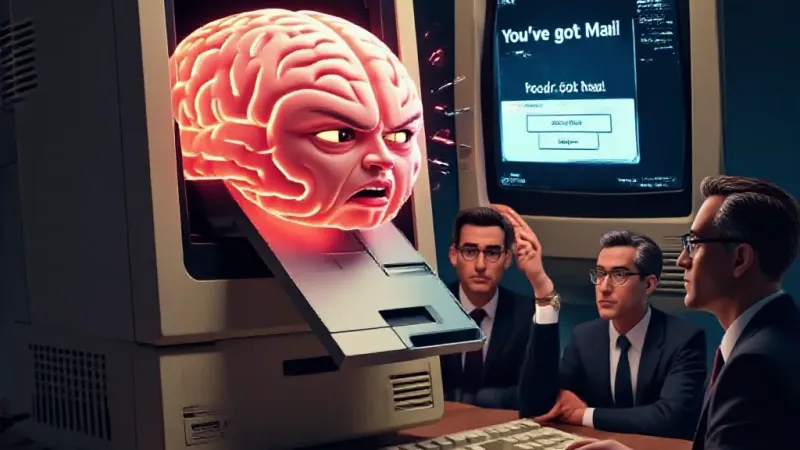
A groundbreaking new study from the Institute for Staggeringly Obvious Business Realities confirms what many IT departments have whispered into their coffee cups for years: artificial intelligence struggles to run on infrastructure designed for an era when "cloud computing" meant checking the weather. The report, titled "Why Is Our AI So Bad? (Spoiler: It's Us)," details how decades-old operating models and legacy systems are fundamentally hostile to advanced neural networks.
"Frankly, we're stunned by these findings," stated Brenda Harrison, CEO of SynergyCorp, a company that recently announced a 100-million-dollar AI initiative while still using Windows 95 for its core accounting. "We assumed simply purchasing 'AI' would magically integrate with our bespoke, COBOL-driven customer relationship management platform. Our AI assistant, 'SynergyBot,' currently just screams 'FATAL ERROR' in a robotic voice when prompted to do anything beyond calculating 2+2, and sometimes it just disconnects, making a sound eerily similar to an old modem." The report highlights a pervasive corporate belief that AI is a plug-and-play solution, rather than a demanding mistress requiring a fully modernized digital ecosystem and, ideally, electricity from the current century.
Researchers cited instances of Fortune 500 companies attempting to feed petabytes of data into systems with less processing power than a modern smartphone, often via manual data entry forms typed into green-screen terminals. One senior analyst, Dr. Ken Thorne, noted, "It's like trying to land a SpaceX rocket on a dirt airstrip built for crop dusters, then realizing the airstrip is actually just painted onto a field of cows. The technology is there, the ambition is there, but the foundational capacity simply isn't. Many executives genuinely thought their 'digital transformation' budget line item would do the actual transforming, assuming the legacy systems would just... politely step aside."
The study also pointed to "innovation theaters" – dedicated corporate spaces for brainstorming future tech, often staffed by employees who still print out emails. These theaters, the report concluded, produce excellent PowerPoint presentations but consistently fail to address the fundamental issues of outdated tech stacks and deeply entrenched bureaucratic processes that view change as a personal affront.
The Institute for Staggeringly Obvious Business Realities plans a follow-up study for next quarter, provisionally titled: "Are Humans Still Required To Turn On Computers?"