
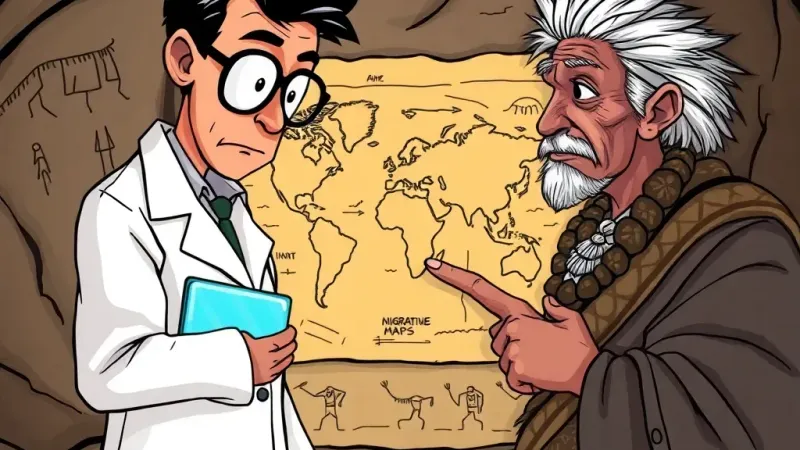
CANBERRA — A groundbreaking new DNA study published this week has definitively confirmed what Indigenous Australians have maintained for millennia: humans first reached the continent approximately 60,000 years ago, utilizing sophisticated seafaring techniques previously dismissed as “anecdotal evidence” by large swathes of the scientific community. The monumental discovery, hailed as a triumph of modern genetic sequencing, essentially verifies the historical narratives passed down through generations of the continent’s First Peoples, albeit with significantly more peer-reviewed jargon.
The research, conducted by a consortium of international universities under the banner of the “Global Ancestry Validation Initiative (GAVI),” meticulously traced maternal DNA lineages across thousands of genetic markers. Researchers isolated specific mitochondrial haplogroups, cross-referencing them with archaeological timelines and complex computational models to conclude that ancestral groups arrived via at least two distinct migratory waves through Southeast Asia. The study’s lead authors celebrated the unprecedented precision, noting that their data aligned remarkably with the “persistent oral traditions of the region’s original inhabitants,” a fact some are calling a “stunning coincidence.”
“This really changes everything,” stated Dr. Alistair Finch, Lead Anthropological Geneticist at the Institute for Obvious Confirmations (IOC), in a press conference. “For years, we relied on archaeological fragments and theoretical models. To have it confirmed by such robust genomic analysis, using a project budget exceeding $80 million, it’s humbling. It shows the incredible foresight of our modeling teams, who were almost exactly right about the region of origin and the general timeframe, pending further grant applications.” Dr. Finch emphasized that the study's primary contribution was providing a “scientifically rigorous framework” for knowledge that had, until now, largely existed outside of peer-reviewed journals.
However, not everyone involved shared the same level of surprise. Elder Miriam Nungarrayi, a spokesperson for the Council of Actual Knowledge, noted the findings with a visible lack of astonishment. “It’s always been in our stories, our songs, our ceremonies,” Nungarrayi remarked, adjusting her traditional possum-skin cloak. “We’ve been telling them for generations, showing them the sites, explaining the journeys. I suppose it’s nice they finally believe us now that it’s been run through a very expensive machine and printed in a journal with a high impact factor.” She added that her ancestors would likely be amused by the “groundbreaking revelation” of facts they considered common knowledge.
Researchers from the GAVI project are now reportedly developing a new, multi-phase research initiative aimed at scientifically confirming additional ancient oral histories, starting with the widespread Indigenous assertion that the sun rises in the east.