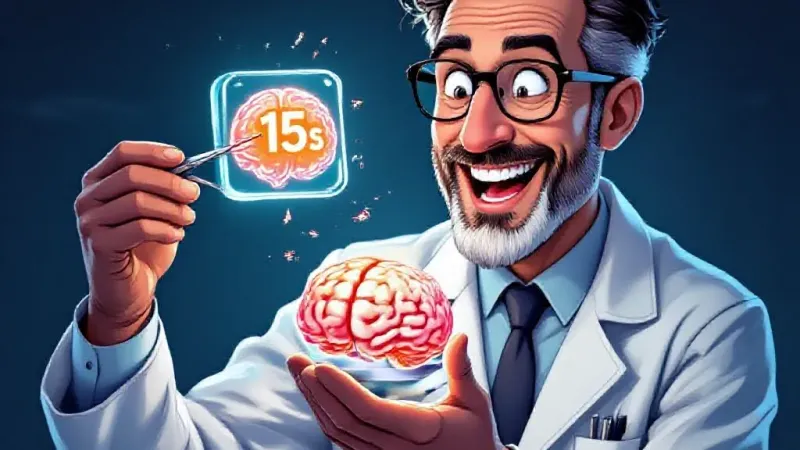
WASHINGTON D.C. — New research from the Institute for Digital Atrophy and Cognitive Compression Studies (IDACCS) reveals that human brains are not merely shrinking with age, but actively restructuring themselves to better accommodate the pervasive influence of short-form digital media. The groundbreaking study suggests our gray matter is undergoing a voluntary, albeit subconscious, self-optimization process, shedding unnecessary neural pathways to more perfectly align with the rapid-fire attention demands of an average TikTok video or Instagram Reel.
Dr. Brenda Neurotropic, lead researcher at IDACCS, explained, "For decades, we attributed cognitive decline to natural aging processes. What we're seeing now is a proactive, almost eager, reduction in gray matter directly correlated with daily exposure to 15-second soundbites, highly curated influencer lives, and an endless stream of reaction videos. Our brains are becoming perfectly streamlined for the content diet they're fed. Why retain complex historical context or engage in nuanced philosophical debate when the next viral dance trend or celebrity gaffe is just a swipe away, delivering a more immediate dopamine hit?" The study tracked thousands of participants over five years, noting significant reductions in areas traditionally associated with sustained focus, critical thinking, and long-term memory formation, while regions linked to rapid pattern recognition and superficial engagement showed increased efficiency.
The findings have ignited a fierce debate within the neuroscientific community, with some hailing it as a natural, albeit accelerated, evolutionary adaptation. "It's not decline; it's peak efficiency," remarked a spokesperson for Gen-Z Media Corp, an anonymous entity rumored to have heavily funded the research. "Why bother with nuanced arguments or the laborious process of reading a book when the collective human experience can be distilled into a 15-second clip of a cat playing piano to an auto-tuned voice? Our species is simply evolving to process information at the speed of virality, leaving more cognitive storage space for future algorithms to occupy. This isn't a problem; it's an upgrade for the attention economy." They suggested that future human brains might achieve unprecedented processing speeds, albeit for increasingly shallow and ephemeral inputs.
Ultimately, IDACCS concluded that this neurological transformation ensures future generations will be perfectly equipped to navigate a world where a Nobel Prize acceptance speech will invariably be edited down to a trending audio, featuring a confused golden retriever.