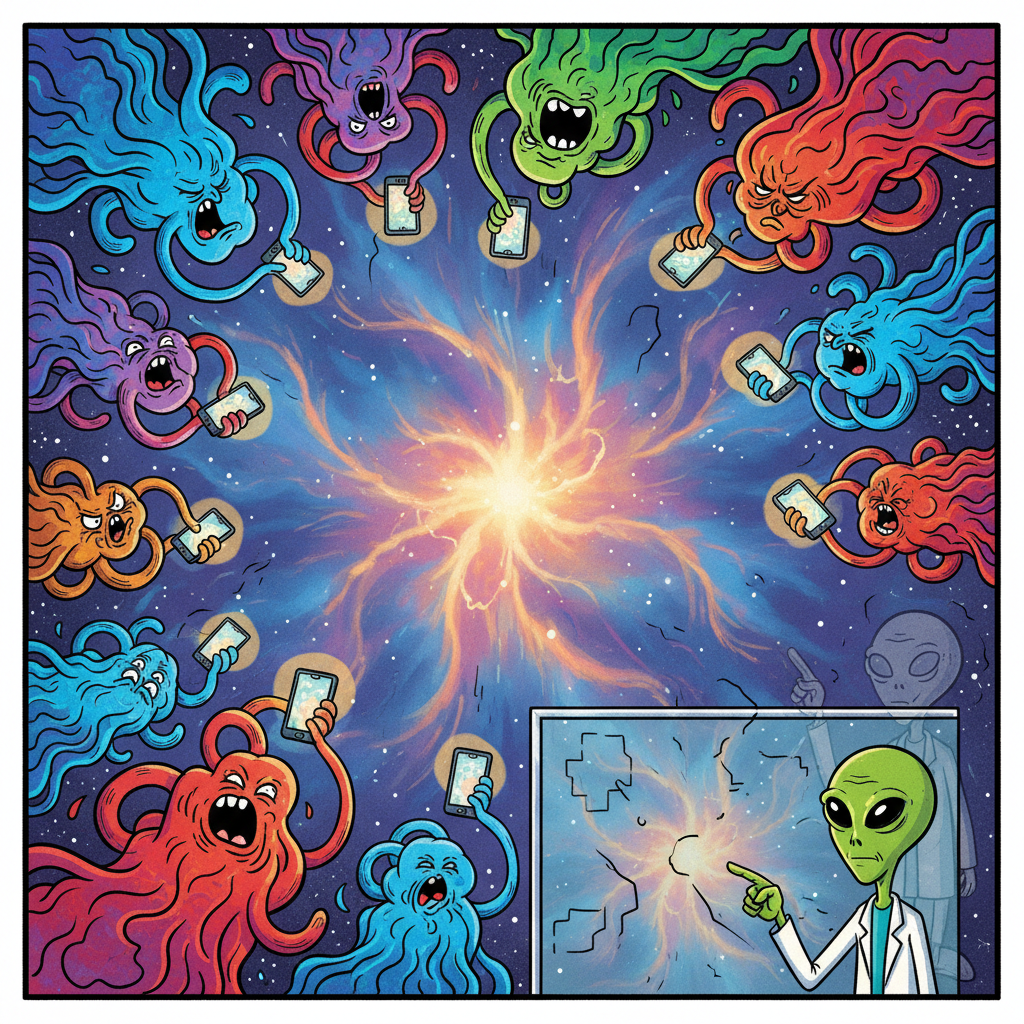
PALOMAR OBSERVATORY – A groundbreaking study published today reveals that the universe's most fertile grounds for the precursors of life are not the dramatic, star-forming regions previously imagined, but rather surprisingly calm, quiet pockets of space where radiation is minimal. Researchers now hypothesize that these 'galactic islands of tranquility' are the cosmic equivalent of a library, where the delicate chemical reactions necessary for complex organic molecules can occur without constant, disruptive interference.
“For years, we assumed life needed a big bang, a fiery crucible, some kind of dramatic cosmic event to get started,” explained Dr. Elara Vance, lead astrophysicist on the project. “Turns out, it just needed a place where the neighbors weren’t constantly throwing gamma-ray bursts. It’s less 'rock and roll' and more 'ambient lo-fi beats to study/relax to' for the cosmos.”
The findings indicate that both the serene core of our own Milky Way and the earliest proto-galaxies shared this unusual quietude. This challenges long-held notions that the most dynamic areas of space were the most promising for abiogenesis. Instead, it seems the universe prefers its foundational chemistry to happen in environments reminiscent of a well-insulated suburban cul-de-sac.
“It’s a bit humbling, really,” admitted Dr. Vance. “All that cosmic drama, all those supernovae and black hole mergers, and it turns out the real work of creating life’s building blocks was happening in the cosmic equivalent of a quiet coffee shop. Makes you wonder what else we’ve been overthinking.” The research team is now reportedly searching for evidence of cosmic 'Do Not Disturb' signs.