
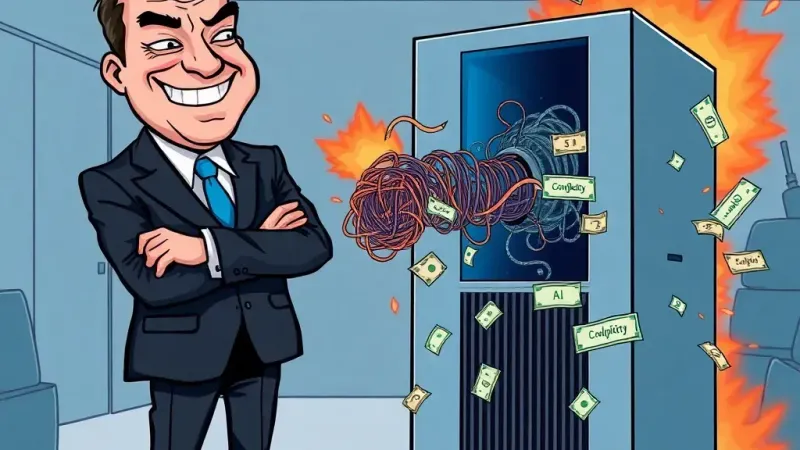
San Francisco, CA – Asana CEO Bartholomew "Bart" Johnson today outlined a bold new vision for the future of work, announcing that generative AI is poised to significantly *increase* workflow complexity across all industries. To address this anticipated surge in digital friction, the productivity software giant will roll out a hybrid pricing model combining traditional seat-based subscriptions with new "AI-augmented workflow complexity units," effectively charging users for the privilege of managing problems AI itself creates.
"For too long, the industry has chased the naive dream of effortless simplification," Johnson stated in an exclusive interview with *Disruptor Monthly*. "But at Asana, we understand the reality: true innovation doesn't reduce complexity; it *elevates* it. Our data shows a direct correlation between advanced AI integration and a 17.3% rise in interdepartmental 'solution-seeking' interactions. This isn't a bug, it's a feature. We're not just selling tools; we're selling the sophisticated scaffolding needed to navigate the beautiful, terrifying labyrinth AI is building for us." He added that early adopters would receive a 10% discount on their first 500 "friction mitigation credits."
Industry analysts largely lauded Asana's pivot as "refreshingly honest." Dr. Evelyn Reed, a leading "AI Accountability and Monetization Ethicist" at the Global Institute for Tech-Enabled Futility, commended the move. "Frankly, the market for 'making things simpler' is oversaturated. The real blue ocean is in 'making things manageable when they become inexplicably convoluted.' Asana is ingeniously repositioning itself from a productivity solution to a vital complexity management partner. It's like selling both the tangled Christmas lights and the dedicated untangling device."
The new pricing structure, set to launch in Q3, will introduce a variable "Dynamic Friction Reduction Premium" based on the volume of AI-generated tasks, communications, and redundant draft documents processed within a user's workspace. Companies can opt for enterprise-tier bundles like the "Chaos Navigator Suite," which includes dedicated "AI Interpretation Specialists" to explain why an AI assigned 30 tasks to a single employee simultaneously. While initial investor reaction saw Asana's stock dip further by 3.8% following the announcement, company spokespeople assure stakeholders that this represents a mere "market recalibration" to reflect the intrinsic value of managing previously nonexistent challenges. "We're not just preparing for the future," said Johnson, "we're proactively building the demand for our solutions by ensuring that future is appropriately perplexing for maximum ROI."
Shareholders are reportedly forming several 'stakeholder complexity task forces' to better understand their own investments.