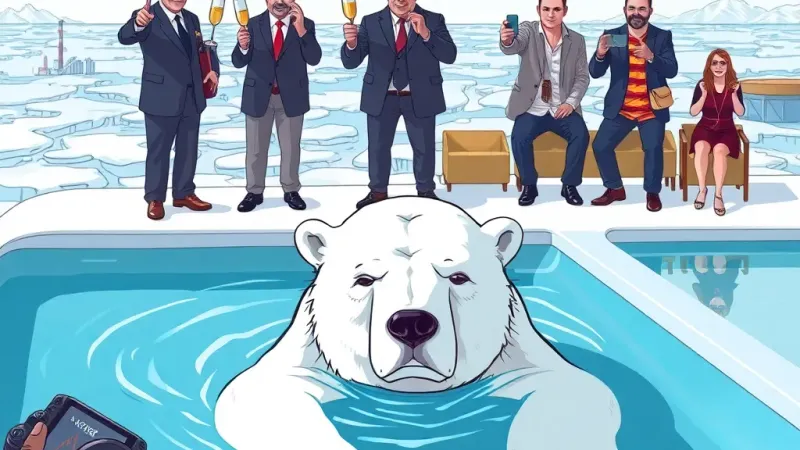
A lone polar bear's unprecedented 427-mile journey through the increasingly ice-free waters of the Arctic is being celebrated by industry leaders as a groundbreaking opportunity for eco-tourism and a testament to "natural resilience." Environmental groups, however, contend the mammoth swim is a desperate act of survival in a rapidly changing habitat, not an invitation for new business ventures.
The Arctic Tourism & Resource Development Alliance (ATRDA) released a statement today applauding the unnamed Ursus maritimus for its "pioneering spirit and innovative adaptation to evolving maritime conditions." Dr. Cassandra Finch, ATRDA's head of Sustainable Engagement Initiatives, hailed the animal's forced migration as a potential "blueprint for future human-animal collaboration in developing scalable, low-impact experiential travel packages." She suggested guided kayak tours following predicted polar bear migration routes, marketed under the tagline "Swim With Resilience."
"We've always known polar bears were tough, but this puts them on par with your most dedicated venture capitalist," Dr. Finch remarked at an online press conference from her climate-controlled office in Oslo. "This isn't about habitat loss; it's about dynamic habitat expansion. These magnificent creatures are showing us how to pivot, how to monetize unforeseen environmental shifts. Who needs ice when you've got 'open water adventure'?" She also floated the idea of 'carbon credit offsets' tied to sightings of long-distance swimming bears, allowing corporations to "invest directly in animal athleticism."
Meanwhile, the International Arctic Conservation Group (IACG) issued a stark counter-statement, calling ATRDA's pronouncements "a staggering display of corporate delusion bordering on outright planetary gaslighting." Dr. Elias Vance, a senior biologist with IACG, stated, "The bear isn't 'pioneering'; it's drowning. It's struggling to find food and solid ground because its home is melting. Celebrating this as a business opportunity is like praising a drowning man for his efficient swimming technique as you sell tickets to watch him go under." Dr. Vance noted that initial tracking data suggested the bear spent approximately 70% of its caloric intake during the swim just trying not to freeze.
ATRDA representatives confirmed that initial market research showed a strong demand for "authentic, climate-adjacent wildlife encounters," especially among those seeking to "connect with nature's incredible adaptability before it's gone."