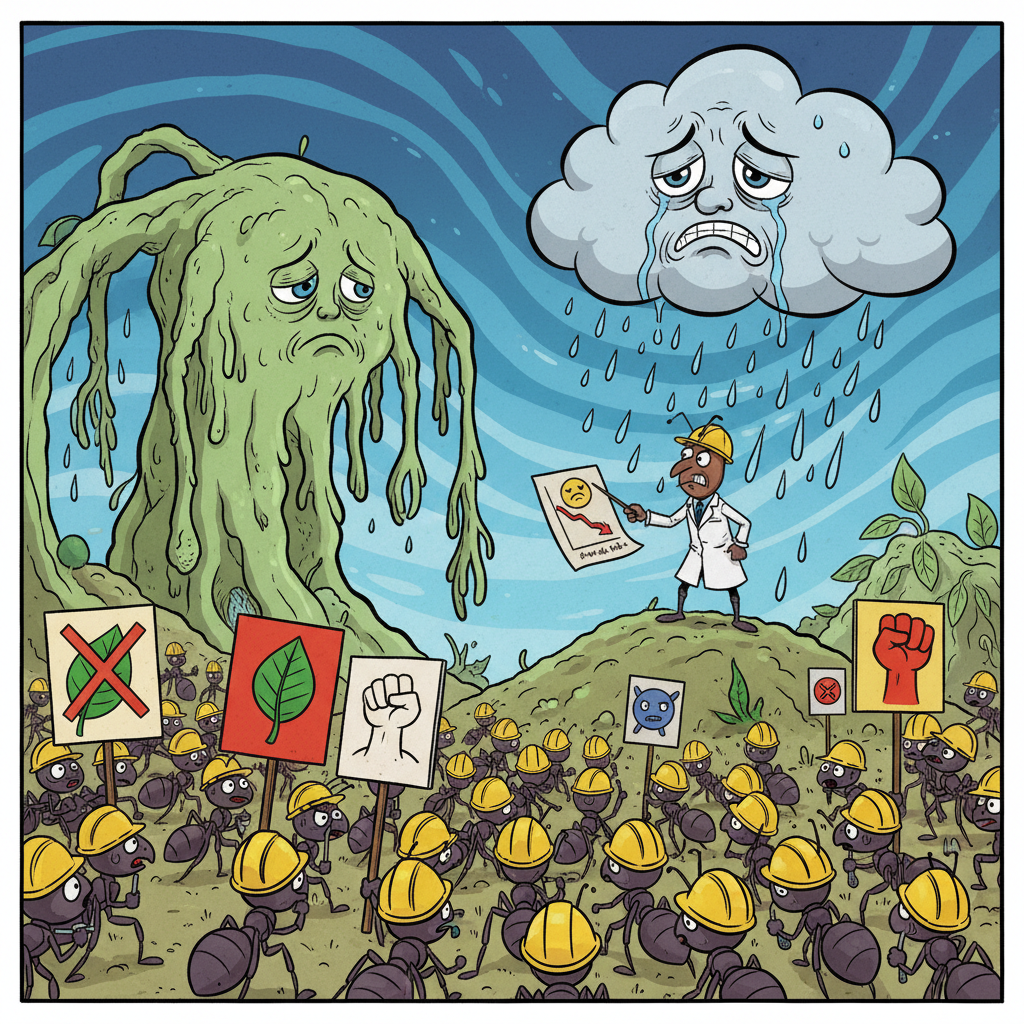
SAO PAULO — A groundbreaking new study from researchers at São Paulo State University (UNESP) and the University of São Paulo (USP) has confirmed what many in the ant community have long suspected: the quality of leaves provided to their fungal gardens directly influences the fungi’s overall health and output. The revelation has sparked widespread demands among leafcutter ants for better, more diverse, and ethically sourced foliage.
“For years, we’ve been telling management that the same old oak leaves just aren’t cutting it,” stated a visibly agitated worker ant, identified only as Unit 734, during an impromptu press conference held near a partially defoliated hibiscus bush. “Our fungal partners are literally the backbone of this colony’s economy, and they deserve a varied diet. It’s not just about calories; it’s about fungal mental health.”
Researchers observed significant shifts in microbial composition and overall garden vitality when ants were provided with a wider array of plant matter. Dr. Elara Vance, lead mycologist on the project, noted, “It appears the fungi, much like human office workers, perform optimally when they feel valued and have access to premium, diverse sustenance. Monotony, even in leaf form, leads to stagnation.”
Colony leadership, represented by Queen Ant Regina III, issued a terse statement acknowledging the findings but emphasizing budgetary constraints. “While we appreciate the scientific rigor, implementing a 'gourmet leaf program' across all 200 million colonies is simply not feasible at this juncture,” the statement read, hinting at a potential future pilot program in a single, high-performing nest.
Meanwhile, Unit 734 vowed to continue advocating for improved working conditions, threatening a 'slow-chew' protest if demands for artisanal, pesticide-free foliage are not met. The study concluded that a happy fungus is a productive fungus, leaving many to wonder if ant colonies will soon be outsourcing their leaf procurement to specialized, ethically-minded foragers.