
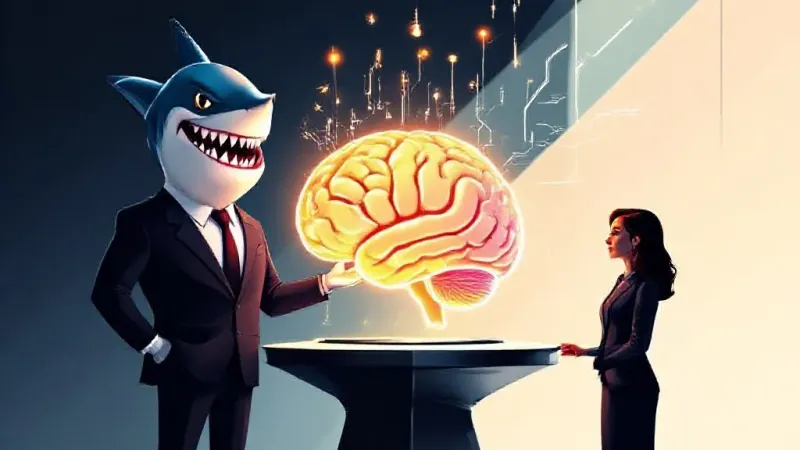
Santa Clara, CA – In a bold move signaling its commitment to artificial intelligence, Advanced Micro Devices (AMD) announced today it has completed the $8.2 billion acquisition of Fei-Fei Li's "World Labs AI firm," a deal insiders confirm includes the immediate transfer of Dr. Li's highly sought-after neural pathways, cognitive functions, and general ability to have original thoughts. The chip giant, historically struggling to articulate a coherent long-term AI strategy beyond "make faster chips," hopes the purchase will finally provide the visionary spark it has apparently been unable to cultivate internally.
"For years, we've been trying to innovate, to truly 'think different' in AI," stated AMD CEO Lisa Su in a press release that conspicuously lacked any actual details of World Labs' existing products or revenue. "But sometimes, you just have to buy the thoughts directly. Dr. Li represents the pinnacle of human ingenuity, and now, that ingenuity is ours. Legally. We anticipate her brain will integrate seamlessly into our Q4 strategic planning meetings, especially the really boring ones." Industry analysts noted the acquisition is expected to generate "at least three or four groundbreaking ideas by 2028," assuming optimal brain-to-power-point conversion rates.
Sources close to World Labs, speaking on condition of anonymity because they feared AMD's newly acquired cognitive abilities, revealed that Dr. Li will retain "day-to-day use" of her brain for activities like eating and remembering where she parked. However, any "significant cognitive output" — defined as anything that could plausibly lead to a patent or a viral LinkedIn post — is now technically AMD's property. "It's a bit like getting a really expensive, highly specialized shared drive," explained one former World Labs engineer. "Except the drive sometimes asks for coffee." Dr. Li herself could not be reached for comment, as she was reportedly in a "mandatory, thought-intensive synergy session" with AMD's senior leadership, reportedly brainstorming new ways to phrase "data throughput optimization."
The deal is expected to set a new precedent for Silicon Valley acquisitions, with many analysts predicting a future where companies simply purchase the entire neuro-biological architecture of prominent thinkers rather than waiting for them to, you know, think. "It’s much more efficient than nurturing internal talent," commented one venture capitalist, already sketching out an IPO for a startup specializing in direct-to-brain thought procurement.