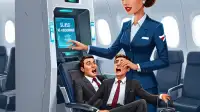
A major U.S. airline, in an unprecedented act of "customer empowerment," has released a comprehensive guide detailing how passengers can secure the "best seat" on their upcoming holiday flights. The 47-page document, titled "Optimizing Your Sky-Pod Experience," quickly clarifies that "best" is now a highly individualized, dynamically priced metric, directly proportional to one's willingness to engage with the airline's newly expanded suite of micro-transactional comfort modules.
Gone are the days of simple window or aisle preferences. The guide categorizes seats not by location, but by their associated "mitigation surcharges," often requiring a PhD in actuarial science to decipher the optimal permutation of discomfort avoidance. For instance, the "smoothest ride over the wing," traditionally a free perk of physics, now requires a $49.99 "Turbulence Abatement Levy," ensuring your bones aren't rattled quite as violently as the economy passengers forward or aft. Seeking a "quiet experience away from engines, galleys, and lavatories"? That’s a "Decibel Deduction Package" starting at $75, available exclusively for rows 21-23 on Boeing 737s, subject to "unforeseen operational adjustments based on passenger demographic profiles and last-minute revenue optimization algorithms," which effectively means the quiet zone may spontaneously relocate mid-flight.
"Our goal is not to nickel and dime, but to empower passengers with choice," stated Chad 'The Algorithm' Sterling, Chief Ancillary Revenue Architect for the unnamed airline, his voice dripping with curated empathy from a pre-recorded statement. "Every passenger has a unique pain tolerance and a unique budget. Our new guide helps them align those two by clearly articulating the precise monetary value of not having a baby scream directly into their ear for six hours, or the luxury of a tray table that doesn't smell faintly of desperation. We're simply monetizing the absence of misery, which we believe is a truly innovative market segment."
The guide also introduces "Dynamic Legroom Coefficients," where an aisle seat's purported "get up and stretch" advantage can be entirely negated if the adjacent passengers have not paid the "Lateral Extension Premium," effectively chaining you to your seat with invisible, yet highly profitable, force fields. Window seats, traditionally valued for views, now offer a "Glare Control Option" at $19.99, because the sun "can be an unpredictable element that impacts comfort, much like the structural integrity of the seat itself, or the unexpected presence of another human being in your personal space." For those truly committed to an undisturbed journey, the "Cargo Hold Tranquility Suite" offers unparalleled legroom and minimal human interaction, starting at just $899, food and oxygen not included, and subject to being routed as "unaccompanied baggage."
Ultimately, the guide concludes, the "best seat" is the one you can afford that allows you to arrive at your destination with the fewest lawsuits pending against your primary sense organs, an increasingly rare and exorbitantly expensive luxury in modern air travel.