


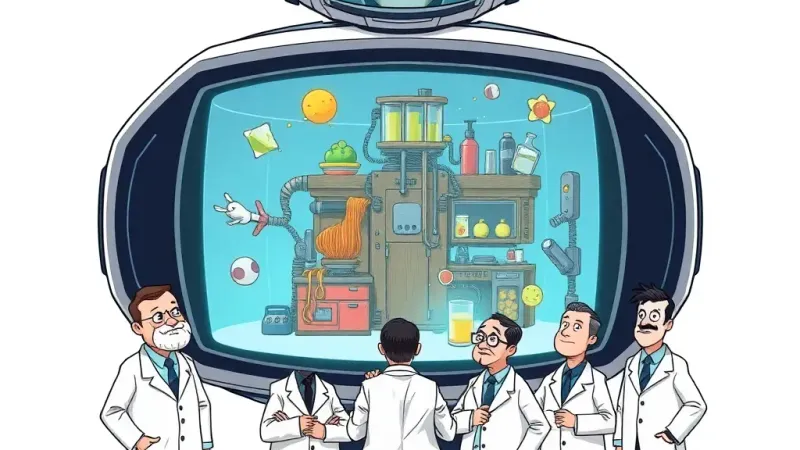
GENOA, ITALY — Scientists at the Italian Institute of 2, in collaboration with Sweden’s Uppsala University and AstraZeneca, announced a groundbreaking supercomputer simulation mapping the intricate motions of a two-million-atom human cell. The research, published in the *Proceedings of the National Academy of Sciences*, offers an unprecedented, high-resolution view into the "chaotic ballet" of fundamental life mechanisms, ultimately confirming that biological processes are, indeed, quite dynamic.
The computational feat involved 10,000 continuous core-hours on the 'Hydra-9000' exascale system, generating approximately 3.7 petabytes of raw molecular choreography data. Dr. Elara Vance, lead computational biologist for the project, expressed awe at the results. "We've always suspected cells weren't just sitting there, but to see it visualized in such granular detail, confirming that things are constantly shifting, merging, and generally operating at a high functional tempo — it’s truly validating," Dr. Vance stated, adjusting her VR headset. "The sheer volume of concurrent micro-operations is, frankly, overwhelming. It’s like a tiny, extremely efficient, very wet bureaucracy, but without the coffee breaks."
This unprecedented digital reconstruction of a spliceosome — a complex molecular machine responsible for editing RNA — provides unparalleled insight into its operational efficiency. "For decades, we relied on static images and educated guesses about what was happening in there," explained Dr. Vance. "Now, we have a complete 3D animation, running at 0.000000001x real-time. It undeniably shows that the spliceosome is, in fact, doing what it does, with a remarkable degree of dedication, and occasionally, a surprising amount of rotational friction in its catalytic core, which we are calling the 'nanoburnout' phenomenon."
While immediate direct therapeutic applications remain, as one researcher put it, "several millennia and a few trillion euros away," the study provides a robust digital playground for future scientific inquiry. Dr. Kian Sharma, a spokesperson for the Italian Institute of Technology, highlighted the research's long-term implications for what he termed "meta-cellular-meta-analysis." "Imagine all the new Ph.D. dissertations that can now be written about the precise angular velocity of a specific hydrogen atom during a key conformational shift, specifically focusing on its potential contribution to theoretical cellular 'impulse buying'," Sharma enthused. "This isn’t just 2; it’s a sustainable academic ecosystem, ensuring generations of grant funding for increasingly niche, visually stunning, and practically inert discoveries."
The team is now reportedly running a follow-up simulation to see if the cell ever considers outsourcing some of its more tedious tasks.