
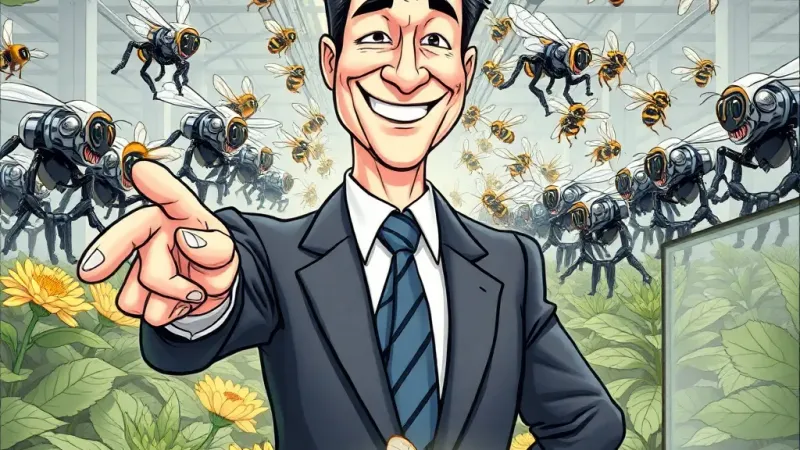
The U.S. agricultural sector today announced a strategic pivot towards "AI-enhanced pollination synergy," a groundbreaking initiative designed to replace the nation's rapidly declining honey bee population with advanced drone technology and proprietary algorithmic solutions. The move comes as commercial beekeepers brace for another catastrophic year, with projected colony losses of 60-70% in 2026.
"While the environmental purists are focused on why the bees are dying, we're focused on how to keep the profits *from* dying," stated Barnaby Thorne, CEO of AgriTech Solutions, a leading developer of the new PollenBot 3000 series. "The fact is, bees are unreliable. They require specific flora, get sick, and frankly, lack ambition. Our AI-driven micro-drones don't need breaks, don't demand fair wages, and can operate 24/7, optimizing pollen distribution with unparalleled precision." Thorne highlighted a recent internal study, "Bee Productivity vs. Unit Cost Analysis: Q4 2025," which purportedly demonstrated that human-managed bee colonies consistently underperformed automated systems in metrics like "blossom-to-harvest efficiency" and "return on ecological investment."
The initiative, backed by a consortium of major food conglomerates including "CornCorp International" and "MegaVeg Partners," plans to deploy millions of "Pollinator-as-a-Service" (PaaS) units across former bee habitats by Q3 2027. Each PaaS unit, roughly the size of a hummingbird, is equipped with a micro-camera, AI navigation, and a proprietary static-charge pollen applicator capable of identifying and fertilizing up to 3,000 blossoms per hour. Critics from the "Concerned Beekeepers Alliance" called the plan "an elaborate, billion-dollar denial of a solvable environmental crisis," but AgriTech responded by noting the Alliance's "outdated reliance on biological organisms."
Industry analysts are hailing the shift as a necessary evolution, transforming an unpredictable natural process into a scalable, data-driven logistical triumph. "This isn't about replacing nature; it's about upgrading it," explained Dr. Evelyn Reed, lead futurist at the Institute for Optimized Ecosystems. "We're moving beyond the messy, inefficient era of 'biological sustainability' into an age of 'engineered ecological resilience.' Think of it as patching a legacy system with a robust, AI-powered update." The USDA reportedly welcomed the "innovative spirit" of the private sector, emphasizing that "free market solutions are always the most delicious."
Observers noted the drones were already struggling to identify the specific flowers mentioned in their programming, largely because those flowers no longer existed.