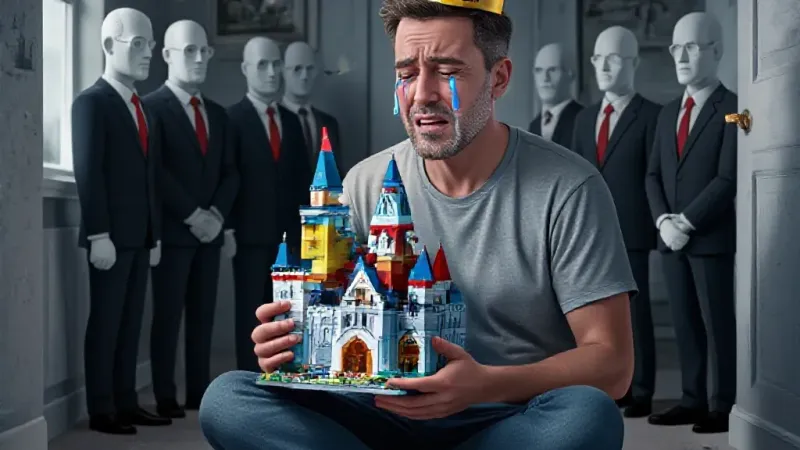
CHICAGO—Local accountant Mark Miller officially became a homeowner Tuesday evening after spending $849.99 on the LEGO Lord of the Rings Rivendell set, marking the first time in his adult life that he has possessed exclusive legal rights to four square feet of structural plastic.
Miller, 35, spent six straight hours on his living room floor meticulously assembling the synthetic fortress, citing a deep human urge to finally control a deed, build a wall, and oversee a property that cannot be unilaterally sold out from under him by a private equity firm.
"Look at this elf balcony," said Miller, pointing to a three-inch slab of molded green polymer. "This is mine. No landlord is going to raise my rent by 18 percent next month because I put a nail in this gray plastic studs piece. If a pipe bursts here, it’s because my cat knocked over the miniature elf fountain, not because a slumlord ignored a black mold outbreak for three fiscal quarters."
Financial analysts confirm that Miller represents a rapidly surging demographic of adult consumers spending billions annually on high-end toys. While previous generations spent their mid-thirties taking out 30-year fixed-rate mortgages and building equity, today’s middle class is channeling their entire discretionary income into heavy-gauge plastic replicas of fictional franchises they remember loving before the global financial crisis of 2008.
According to market research, the average adult toy purchase provides 100 percent of the emotional gratification of adulthood at roughly 0.04 percent of the cost of a down payment on a two-bedroom starter home.
"We are seeing a total collapse of traditional milestones being replaced by micro-doses of manufactured nostalgia," said Dr. Aris Thorne, senior fellow at the Center for Applied Consumer Coping. "When a generation realizes they will never own land, afford child care, or retire before the sun consumes the inner planets, they naturally pivot to buying a $400 plastic replica of the Millennium Falcon. It gives them something to dust during the two hours of free time they have between their remote corporate job and their secondary gig-economy delivery hustle."
For Miller, the purchase provided a fleeting sense of mastery over his environment that no modern financial instrument could offer.
"I tried saving for a down payment in 2021," Miller explained, carefully snapping a tiny plastic flag onto a mini tower. "I saved forty thousand dollars. But then housing prices jumped thirty percent, mortgage rates doubled, and my health insurance deductible wiped out my liquid emergency fund. Buying a plastic castle meant I could hand over three pieces of paper with Benjamin Franklin's face on them and walk out of a store with a physical structure I actually own. Sure, I can't stand inside it, but honestly, the square footage is comparable to the micro-studio I rent in Logan Square."
Toy manufacturers have quickly recognized the shift, abandoning children entirely to focus on burnt-out corporate professionals who desperately need to spend $200 on an artificial plastic bonsai tree to feel connected to nature after sitting in fluorescent light for twelve hours.
"Children don't have credit cards with $15,000 limits and high-grade existential dread," said Hasbro marketing consultant Brenda Vance. "Kids play with a toy for twenty minutes and get bored. An adult manager who spent nine hours in Zoom calls resolving cross-functional operational friction will sit silently on the carpet for six hours, crying tears of joy as they assemble a plastic Optimus Prime. That is a customer for life."
At press time, Miller was seen furiously debating whether he could afford to expand his estate by purchasing the $600 LEGO Barad-dûr tower, ultimately deciding that taking out a second line of credit on his kidney was worth becoming the undisputed ruler of Mordor.