
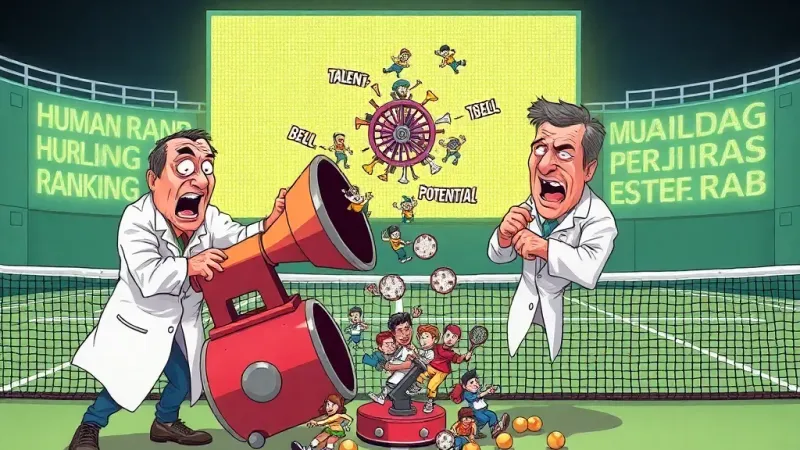
STUTTGART — The recent spate of unexpected losses at the Porsche Tennis Grand Prix, including the early exits of second-seeded Coco Gauff and third-seeded Iga Swiatek, has reportedly triggered a global emergency within professional tennis, with leading analysts now openly questioning the fundamental utility of any ranking system whatsoever. Authorities suggest the sport may simply be a series of individuals hitting a ball over a net until one of them stops, rendering all pre-match prognostications and numerical designations essentially null.
"Look, when your top-tier athletes can lose to players ranked fifty spots below them on any given Tuesday, what are we even doing?" pondered Dr. Evelyn Reed, lead quantitative nihilist at the International Institute of Sporting Absurdity. Dr. Reed's groundbreaking new white paper, "The Inevitability of Chaos: Why Everyone is Equally Likely to Win on Any Given Day," argues that the WTA's current algorithm-based probability metric is now statistically indistinguishable from a coin toss weighted by who got better sleep. "Our competitive integrity index has plummeted 37% this quarter alone. At this rate, we'll hit zero by Wimbledon. We're effectively just tracking who has the most frequent flyer miles, or perhaps the best pre-match bagel."
The implications extend far beyond mere sports betting. Media outlets, once reliant on compelling narratives of established rivalries and predictable champions, are struggling to frame matches where any player might suddenly "unlock" their latent potential or inexplicably forget how to serve a simple second ball. Broadcasters are reportedly considering pre-recording multiple victory speeches for every participant, or simply airing a generic congratulations to "whomever managed not to double-fault on match point today." Major sponsors are reportedly reviewing multi-million dollar contracts, unsure if their investment in a "top player" holds any significant brand value when that player can be eliminated in the early rounds by someone whose highest previous achievement was winning a local pickleball tournament. The very concept of "world No. 1" is now under severe scrutiny, with some advocating for a rotating ceremonial title based on alphabetical order.
"We understand that fans thrive on predictability and the illusion of meritocratic ascent," stated Brenda Chen, WTA Interim Director of Competitive Narrative, in a hastily convened press conference held entirely in a soundproof bunker. "However, the data now indicates that the only consistent outcome is inconsistency. We're exploring alternative frameworks, such as assigning rankings based on who has the most Instagram followers, or perhaps a monthly lottery draw from a gilded urn. Anything to provide some semblance of order before the entire system devolves into highly paid people just swatting a ball aimlessly for prize money and exposure on obscure streaming platforms." She added that initial proposals include mandatory "surprise" match conditions, like playing with a golf ball or while wearing roller skates, to normalize the inherent unpredictability.
As the WTA grapples with its existential crisis, spectators are left to ponder the unsettling possibility that perhaps, in the grand scheme of athletic competition, individual skill and consistent performance are merely quaint anecdotes, and that absolutely anything can happen at any moment, and therefore, nothing truly matters beyond the fleeting enjoyment of a well-placed drop shot.
The good news is, anyone could theoretically be the world's number one tennis player tomorrow, provided they can hit a forehand and locate Stuttgart on a map.