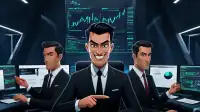

The financial sector is in an uproar. A 5% Treasury yield, traditionally a sign of a healthy economy where money can safely grow, has been branded an "existential threat" by prominent fund managers and economic pundits. Their primary concern: it gives regular people an alternative to their meticulously crafted, highly leveraged, and often baffling financial products.
"How are we supposed to convince pension funds to invest in our meticulously crafted, highly leveraged derivative products when they can just put it in a T-bill and get five percent?" lamented Mortimer 'Muffy' Vanderbilt III, CEO of Global Gambit Capital, from his Hamptons yacht, which he assured reporters was "barely breaking even" this quarter. "This isn't just about borrowing costs; it's about the erosion of the fundamental incentive structure that keeps capital flowing to the... creative corners of finance. We're talking about basic human psychology here: why bother with genius when mediocrity pays?"
Analysts at the newly formed "Institute for Essential Wealth Extraction" warned that if unchecked, a 5% yield could lead to "unprecedented stability" in retirement portfolios, severely impacting the quarterly bonus pool for those tasked with managing said instability. "The average investor might actually *keep* their money without us having to 'optimize' it for them," read a leaked internal memo from the Institute. "This goes against everything we've built, which, frankly, is a multi-trillion-dollar industry predicated on the idea that *only we* can make your money work for you, preferably with a healthy management fee attached."
The Federal Reserve is reportedly under immense pressure to "re-evaluate" its stance on interest rates, with calls to lower them back to zero, or even negative, to "restore market confidence" and "ensure liquidity" – code words, sources close to the matter suggest, for re-inflating asset bubbles and making speculative trading profitable again. The White House remained tight-lipped, but anonymous sources indicated President Biden was "deeply concerned" that Grandma might actually be able to afford gas without risking her life savings on meme stocks or high-risk private equity funds.
"It’s a crisis of imagination," quipped one visibly shaken hedge fund manager, gesturing wildly at his bespoke suit. "We’ve become too reliant on an environment where the 'risk-free' option was essentially a donation. Now, we actually have to *compete*? With safety? It’s simply not fair. Where's the challenge? Where's the thrill of potentially ruining someone's retirement to hit Q4 targets? The whole industry feels... exposed."
The true risk, according to these financial titans, isn't the cost of government borrowing, but the threat of financial literacy spreading to the masses. When people realize they don't *have* to gamble their nest egg on crypto or get-rich-quick schemes just to keep pace with inflation, the entire facade of complex, opaque investment strategies begins to crumble.
For an industry built on promising returns from high-risk ventures, the biggest danger wasn't a recession or a housing collapse, but the terrifying prospect of a perfectly safe investment actually delivering a respectable profit.