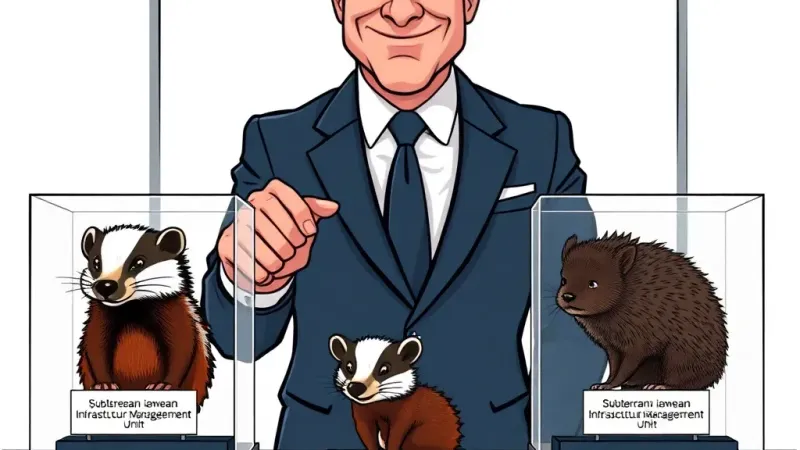
LONDON – A landmark study identifying a critical 20-year window to avert irreversible biodiversity decline across Great Britain has prompted swift government action, with officials confirming plans are already underway to "strategically repurpose" the nation’s remaining natural assets for maximum economic value. The report, from the UK Centre for Ecology & Hydrology (UKCEH), warned that the UK, already one of the world's most nature-depleted countries, faces an unprecedented ecological crisis if immediate decisions on land use are not made.
"While some might see this as a warning, we see it as a clear timeline for optimizing our natural resource portfolio," stated Dr. Alistair Finch, Head of Ecological Asset Monetization at the newly formed Department for Environmental Opportunity (DEO). "Twenty years gives us ample time to transition these underperforming ecological parcels into high-yield, sustainable investment opportunities. We’re talking 'biodiversity offsets' that actually offset something, 'rewilding' initiatives sponsored by luxury housing developments, and 'natural capital' that generates actual capital."
Sources within the DEO confirmed that preliminary blueprints for "Bio-Parcel Redevelopment Zones" are already being drafted. These zones, currently home to dozens of native bird, butterfly, and plant species, are envisioned as prime locations for next-generation data centers, carbon-neutral logistics hubs, and bespoke eco-resorts catering to the ethically conscious elite. "Imagine a rare butterfly habitat, now a thriving micro-grid powered by wind turbines, surrounded by artisan coffee shops and charging stations for electric SUVs," Dr. Finch explained, gesturing enthusiastically at a holographic projection. "That's not just a vision; that's a prospectus."
The study's lead author, Professor Evelyn Reed of UKCEH, expressed a nuanced perspective on the government's response. "Our findings indicated a need for *conservation* and *restoration* to prevent species loss," she clarified in a separate press conference. "We did not, to my recollection, recommend re-zoning critical habitats for 'synergistic multi-use infrastructure projects.' But I suppose in 20 years, even the concept of a 'wild bird' might require an interpretive plaque."
Environmental advocacy groups cautiously welcomed the clarity, noting that at least now everyone knows precisely what the plan *isn't*. "For years, we've had vague promises about protecting nature," said Sarah Jenkins, spokesperson for 'Save the Last Blade of Grass.' "This new approach, while deeply unsettling, is commendably direct. They’re telling us exactly when and how they intend to finish the job."
The public has been assured that any 'repurposed' areas will feature "augmented reality biodiversity experiences," ensuring future generations can still witness digital representations of what used to be real, right outside the window of their climate-controlled pod.