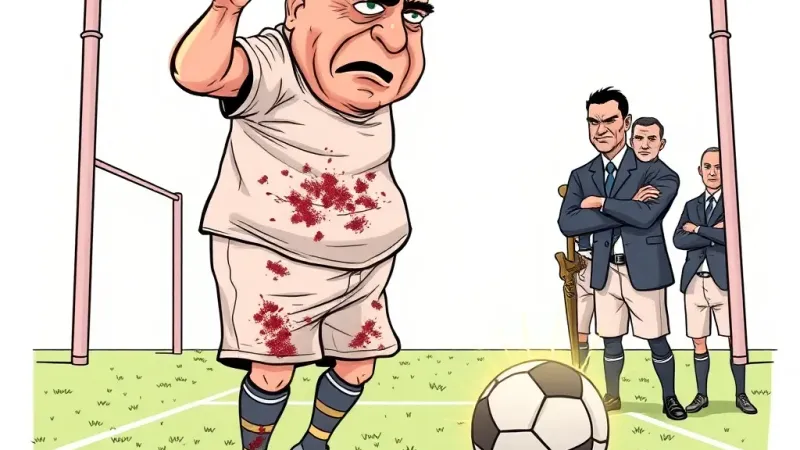
I was, as one typically is on a Tuesday morning, enjoying a particularly strong Earl Grey and perusing the more scandalous society pages when the news, or rather the query, regarding a certain Mr. Mark Williams' Sunday activities intruded upon my peace. One always assumes that the affairs of the court, or perhaps the latest diplomatic faux pas, would dominate the week's concerns, not the athletic schedule of a gentleman named Williams. Yet, here we are, facing down a matter of far greater import than mere points on a scoreboard: the very essence of our Sunday expectations.
Let us be unequivocal: Mark Williams, regardless of his current corporeal disposition or the transient whims of his team's strategic 'needs,' simply must play on Sunday. This is not a matter of competitive advantage, nor is it about the crass pursuit of victory, a concept often lauded by those who mistake exertion for elegance. No, this is about something far more fundamental: the solemn, almost ritualistic, observance of a Sunday spectacle.
Sundays, as any discerning individual knows, are a different breed of day. They are not merely the tail end of the week, but a societal pillar, a day meant for measured engagements, for the gentle turning of pages, for the hushed murmur of polite conversation, and, yes, for a carefully curated public display of collective purpose. A professional basketball game on a Sunday, particularly one that promises a certain degree of pomp and circumstance, is not merely entertainment; it is a civic duty, a communal affirmation of structured leisure.
The idea that Mr. Williams might not grace the court, due to some ephemeral 'injury' or 'discomfort,' strikes at the very heart of this understanding. His absence would leave not just a vacancy in the roster, but a gaping hole in the aesthetic and moral fabric of the afternoon. One attends these events, not necessarily to witness unprecedented feats of athleticism, but to participate in the shared experience, to observe the orderly procession of bodies in motion, and to reaffirm the delicate balance of our civilized amusements. To deny the public the presence of a central figure—for is not a 'center' by definition central?—is to deny them a crucial anchor in their Sunday routine.
One hears whispers, of course, about "recovery protocols" and "medical advice." While admirable in their own small way, such pedestrian concerns entirely miss the larger societal tapestry. The public has an expectation, a quiet, unspoken demand, for the consistent presence of its appointed performers. To allow a minor physical inconvenience to disrupt this profound social contract is to misunderstand the very nature of public life. We expect our actors on the stage, our politicians at the podium, and indeed, our athletes on the court, to fulfill their roles. Anything less is a betrayal of the common good.
Therefore, I implore all involved, from the trainers with their ice packs to the coaches with their clipboards: ensure Mr. Williams takes to the court. His presence is not merely beneficial; it is essential for the spiritual integrity of our collective Sunday.
Sometimes, one must simply appear.