

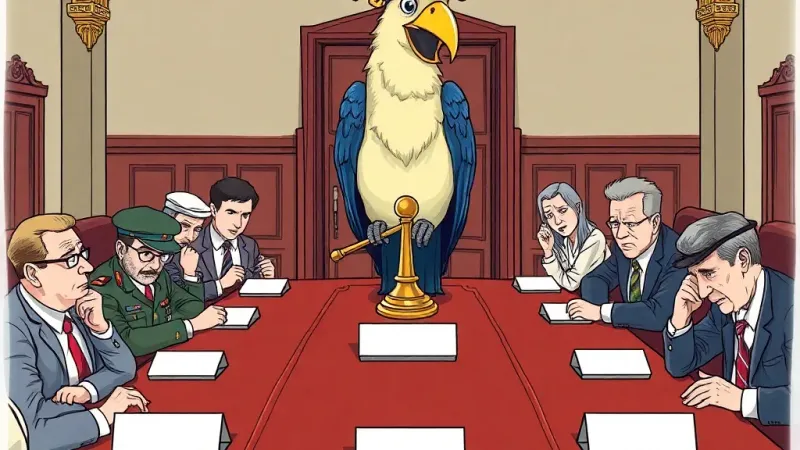
The scientific establishment, with all its fancy degrees and endless grants, has finally stumbled upon a truth I, Chadwick Bronson, have been intuiting for years: parrots are not just mimicking us, they're showing us a better way to live. Specifically, a better way to communicate. And it involves ditching the ridiculous, inefficient, and frankly primitive practice of personal names.
Yes, you read that right. Your "Bob," your "Susan," your "Brenda"—they're relics of a bygone era. A recent "study" (and I use that term loosely, as true wisdom comes from within, not a petri dish) confirms that parrots don't just squawk nonsense; they use "proper names" to identify individuals. But here's the kicker, folks: they're not merely repeating sounds; they're demonstrating a profound leap in communication that we, the supposedly intelligent species, have yet to grasp.
Think about it. We burden ourselves with unique identifiers from birth. "What's your name?" "How do you spell that?" "Is that with a 'C' or a 'K'?" The mental bandwidth wasted on remembering, recalling, and correctly articulating these arbitrary labels is staggering. Imagine if that brainpower were freed up. We could be solving cold fusion in our garages, perfecting the art of sourdough without a starter, or finally figuring out why socks always disappear in the dryer. Instead, we're stuck in the linguistic Stone Age, pointing at each other with labels.
Parrots, those iridescent beacons of wisdom, have seen through this charade. They don't invent names. They *absorb* the essence of a person's designation, distill it, and deploy it with an efficiency that shames our clumsy attempts. When a parrot chirps "Laura," it's not just a phonetic repetition; it's the *Platonic ideal* of Laura, unburdened by ego, social constructs, or the awkwardness of having two "John Smiths" in the same room. It's a pure identifier, a vibration of recognition that transcends mere appellation. Their "mimicry" is not a flaw; it's a feature, an evolutionary shortcut to a higher form of collective identity.
"But Chadwick," I hear the nay-sayers squawk, "how will we tell people apart? It's chaos!" To them, I say: Are you dumber than a dog? Dogs distinguish their owners, their friends, their enemies, all without the need for a convoluted string of syllables. They use context. Scent. Body language. Subtle energetic cues. Are we, the pinnacle of evolution (or so we delude ourselves), incapable of such nuanced discernment? Of course not! We simply haven't been forced to adapt, until now.
Scientists, bless their little hearts, are quick to call this "mimicry." They're missing the forest for the feathers! They see a bird repeating "Sparky," I see a glimpse into a post-nominal future, a society unchained from the tyranny of personal branding. This isn't mimicry; it's appropriation for advancement. It's an upgrade.
So, what's the call to action? Simple: Start practicing. Look your colleagues, your family, your barista in the eye, and for the love of all that is feathered and wise, stop calling them by their names. Experiment with subtle head tilts, a specific eye glint, a unique melodic hum to indicate recognition. Embrace the discomfort. The parrots are watching, judging, and quite frankly, waiting for us to catch up. It’s time we shed our linguistic shackles and truly soar.