
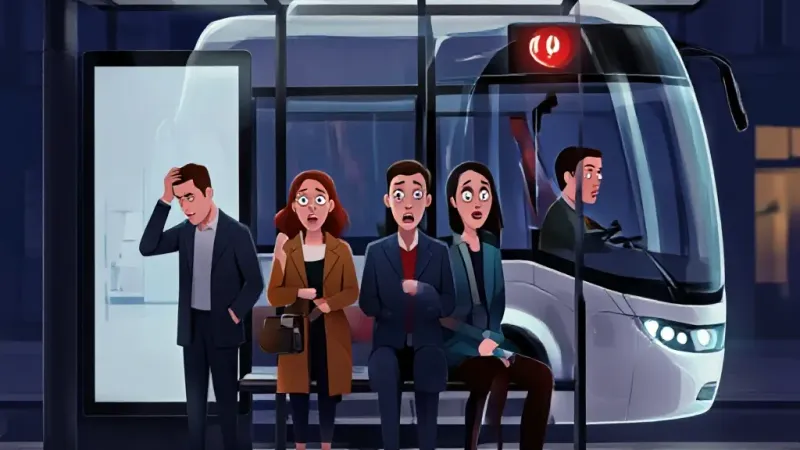
LONDON — Transport for London (TfL) has quietly launched a revolutionary new pilot program designed to fundamentally alter how commuters perceive public transit, starting with the now-famous "Bus Stop M." Dubbed the "Cognitive Dissonance Enhancement Initiative," the program intentionally subjects passengers to conflicting information regarding bus stop availability, fostering critical thinking and emotional fortitude in the face of bureaucratic ambiguity.
"For too long, commuters have enjoyed the false comfort of predictable bus schedules and clear signage," stated Dr. Fiona Bixby, Head of Disruptive Transit Solutions at TfL's newly formed Department of Algorithmic Transit Uncertainty. "Our data indicated this created a passive, almost childlike reliance on the system. The 'existential crisis' program, by contrast, challenges passengers to actively interrogate reality. Is the stop coned off for phantom roadworks, or is it merely undergoing a philosophical closure? The answer is less important than the journey of inquiry itself."
Bus Stop M, a prototype for this bold new future, spent five bewildering days last week alternating between being officially "closed" by cones and laminated posters declaring "Roadworks in Progress," while simultaneously appearing fully active on TfL's official apps and displaying live countdowns for non-existent buses. Commuters reported an invigorating sense of intellectual challenge. "At first, I was annoyed," admitted regular commuter Brenda Holloway, 57, clutching a printout of a bus schedule from three weeks ago. "But then I realized, this is training. This is preparing me for the modern world where nothing is certain and every piece of information is a potential lie. Now, I carry a whistle and a compass everywhere, and I talk to the pigeons about the nature of being."
A leaked internal memo, marked "PROJECT: SCHRÖDINGER'S STOP," detailed the program's objectives, including "optimizing frustration pathways" and "cultivating a heightened sense of precarity among the traveling public." The document emphasized the psychological benefits: "By forcing passengers to constantly re-evaluate their surroundings and digital interfaces, we not only reduce screen-time dependency but also stimulate neuroplasticity, potentially delaying cognitive decline." Early metrics suggest a 15% increase in "situational awareness" and a significant uptick in commuters developing "personal theories of reality," which TfL considers an unqualified success. The program also recorded an unmeasured but noticeable increase in passengers simply walking, which Dr. Bixby hailed as "a clear win for both pedestrian health and traffic reduction, effectively turning a service into a spontaneous fitness regimen."
TfL plans to roll out the "existential crisis" model to an additional 200 stops by year-end, promising a future where every commute is an opportunity for personal growth, a desperate search for meaning, and potentially, a chance encounter with a bus that might or might not be coming. Future phases, according to the memo, may include dynamically altering bus routes mid-journey, replacing driver announcements with philosophical riddles, and occasionally disappearing entire stops for a "pop-up urban wilderness experience."