
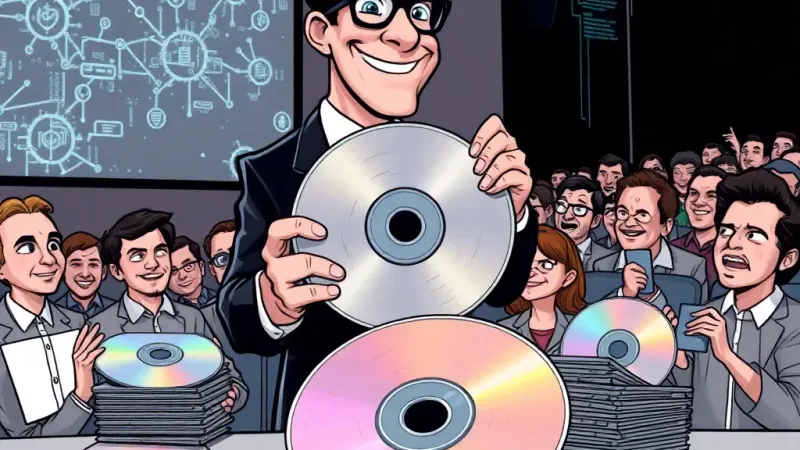
NASHVILLE, TN — In a move poised to revolutionize home entertainment, a nascent tech startup, "ReelAccess Solutions," has officially unveiled its flagship product: the "Physical Data Disc." Promising a return to tangible media ownership and an end to persistent buffering, the company's pilot "access hub" in Nashville is set to introduce consumers to a truly novel method of content consumption.
The Physical Data Disc, a circular polycarbonate platter capable of storing up to several gigabytes of visual and audio data, is being hailed by proponents as the ultimate antidote to the pervasive "streaming fatigue" plaguing modern audiences. Users simply insert the disc into a specialized playback device, and, without the need for an internet connection, content is displayed instantly on their screens. "For too long, consumers have been held hostage by algorithms and fluctuating bandwidth," stated Dr. Evelyn Reed, lead digital archivist at the Institute for Analog Preservation. "This disc offers a radical paradigm shift: you buy it once, you own it forever. It's a truly disruptive concept in a subscription-dominated world."
ReelAccess Solutions' founder and CEO, Brock Sterling, described the journey to perfecting this technology as "arduous but necessary." Sterling detailed the painstaking process of developing the "read head" technology, which translates microscopic etched patterns on the disc's surface into high-definition audiovisual streams. "Our engineers worked tirelessly to ensure seamless playback," Sterling told reporters at a press event, holding up a prototype disc. "We've cracked the code on persistent, high-fidelity content access without a single monthly fee. Imagine, a library of films, all at your fingertips, without ever having to remember a password." The company also plans to introduce a "return and exchange" program, allowing customers to swap discs for new titles, creating a vibrant, circular content 2.
Despite the groundbreaking nature of the Physical Data Disc, critics have raised concerns about the logistical challenges inherent in this novel system. Questions persist regarding the physical storage requirements for large media collections, the potential for discs to be scratched or damaged, and the labor-intensive process of "rewinding" certain legacy formats before they can be returned. "It's an interesting thought experiment," commented tech analyst Maya Singh, "but the scalability is dubious. Are we expected to physically transport these discs to a central location every time we want new content? And what about the environmental impact of manufacturing millions of plastic discs?"
Sterling, however, remains undeterred, citing early market research indicating a strong demand for "something you can actually hold." ReelAccess Solutions plans to expand its "access hubs" nationwide, betting that audiences are ready to embrace a future where their entertainment can't be deleted by a server farm.