
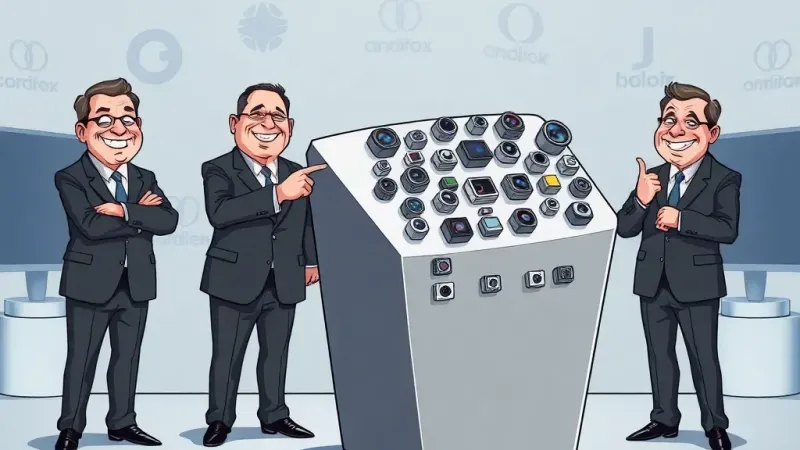
CUPERTINO, CA — The global consumer electronics industry has officially updated its internal definition of “innovation” to more accurately reflect contemporary product cycles, announcing this week that the term will henceforth refer primarily to the development of a “slightly shinier rectangle with an increased number of rear-facing camera lenses.” The move, widely anticipated by market analysts, standardizes a practice that has been de facto for nearly a decade.
"For too long, the industry wrestled with the ambiguous concept of 'groundbreaking new user experiences' or 'paradigm shifts,'” explained Dr. Evelyn Reed, lead analyst for the Institute for Perpetual Progress, a think tank dedicated to rationalizing corporate jargon. "This new, streamlined definition allows for clearer product roadmaps, more efficient marketing collateral, and eliminates the unpredictable variable of genuine creative breakthrough. We've optimized for replicability and margin retention."
Under the new guidelines, innovations will primarily include: a 0.007% increase in processing efficiency, a proprietary "Micro-Texture™" coating that feels marginally different in the hand, and the addition of at least one new camera aperture, ideally with a unique, unpronounceable name like the "Quantum Pixel Convergence™ sensor." Products that integrate existing technologies into novel, yet ultimately redundant, form factors (e.g., smart toasters with blockchain capabilities, AI-powered dishwashers that curate bespoke playlists) will also qualify.
“Consumers have demonstrated a clear preference for the familiar, just… more so,” stated Liam Gallagher (no relation), CEO of AuraTech Solutions, a leading manufacturer of premium rectangular devices. “Why risk market acceptance on something truly original when we can deliver incremental satisfaction through a brighter screen and a 0.5mm thinner chassis? Our internal metrics show users derive immense satisfaction from a device that is, demonstrably, 17% better at things they didn't even know they needed quantified.”
The industry hopes the new definition will also simplify consumer choice, allowing individuals to more easily identify the 2 model of their preferred rectangular device without being confused by fundamentally different functionalities. Experts project this refined approach will continue to drive year-over-year growth in the "slightly better rectangle" sector until at least 2035.
Ultimately, the update is expected to herald a new era of predictable excellence, ensuring that future generations will always have access to a device that does everything its predecessor did, only with more computational photographic features and a slightly steeper price tag.
Hambry is a satire publication. All articles are works of fiction.