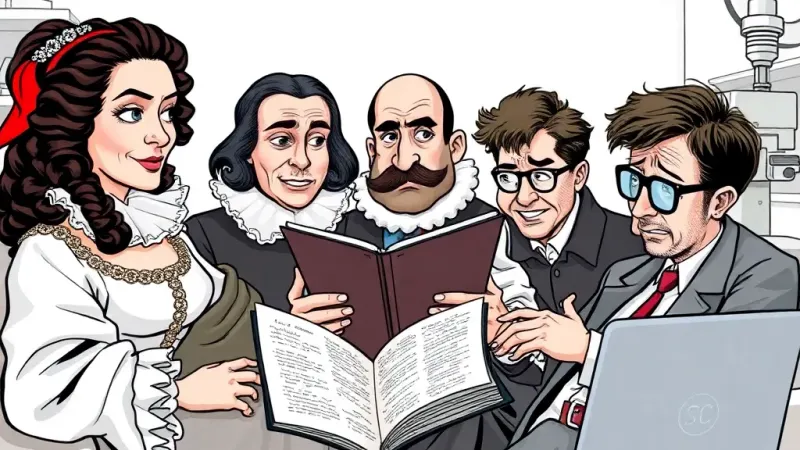
A groundbreaking study by the Institute for Obvious Conclusions (IOC) has confirmed that William Shakespeare’s original plays, written over four centuries ago, remain largely understandable to a small, dedicated segment of the global population. This research definitively proved that certain individuals possess the cognitive faculties to follow complex narratives and archaic vocabulary without the aid of a graphic novel adaptation, a TikTok dance-off interpretation, or a gritty, dystopian streaming series. The findings have sent ripples through the entertainment industry, which has spent decades perfecting the art of "contemporizing" the Bard for wider appeal.
The findings, published this week in the *Journal of Redundant Research*, indicate that a surprising 0.7% of respondents could discern the plot and overarching themes of *Hamlet* without requiring a 15-minute YouTube explainer video. This highly specialized cohort primarily consisted of literature academics, theater historians, and several individuals who described themselves as "just really into old books." Dr. Alistair Finch, lead researcher for the IOC, noted, "For generations, we've assumed Shakespeare’s work was inherently opaque to the average person, necessitating constant 'relevance injections.' This study provides empirical evidence that, yes, some people *can* still understand 'thee' and 'thou' without a detailed anachronistic infographic."
Dr. Finch clarified that the study specifically excluded participants whose understanding of Shakespeare was solely derived from watching *10 Things I Hate About You* more than five times, or those who claimed mastery after attending a "Shakespeare in the Park" performance where actors predominantly mimed the plot to a playlist of early 2000s rock anthems. "Our goal was to identify pure, unadulterated comprehension, free from the crutch of superficial 'modernity'," he explained. "It was significantly harder to find suitable participants than we initially anticipated, largely because most of our initial pool just kept asking if we had a trailer for the original version."
The study also observed that this "niche audience" showed elevated levels of attention span and a baffling tolerance for complex sentence structures, traits increasingly rare in an entertainment landscape optimized for rapid-fire content consumption. These individuals exhibited a marked preference for live stage performances and textual analysis over "reimagined" content, despite the latter’s frequent inclusion of contemporary social commentary, gratuitous slow-motion fight sequences, and product placements for artisanal kombucha.
"While we commend the resilience of this small market segment, our data unequivocally proves that the future of intellectual property monetization lies in maximum accessibility and minimal cognitive load," stated Brenda Sterling, Head of Legacy Content Refurbishment at Global Media Innovations Inc. "Original verse, while charming in its historical context, simply doesn't scale to modern engagement metrics. Our market research shows that a *Romeo and Juliet* set in a competitive e-sports league, with all dialogue replaced by Twitch chat and emotes, has significantly higher Gen Z engagement metrics than, you know, just *reading* the original play." She added that adapting Shakespeare to reflect the current political climate, regardless of the original themes, was "critical for brand synergy and a robust ESG score."
Researchers are now seeking grants to determine if these "original Shakespeare" enthusiasts also prefer reading books made of actual paper or, more disturbingly, enjoy silent films without background music.