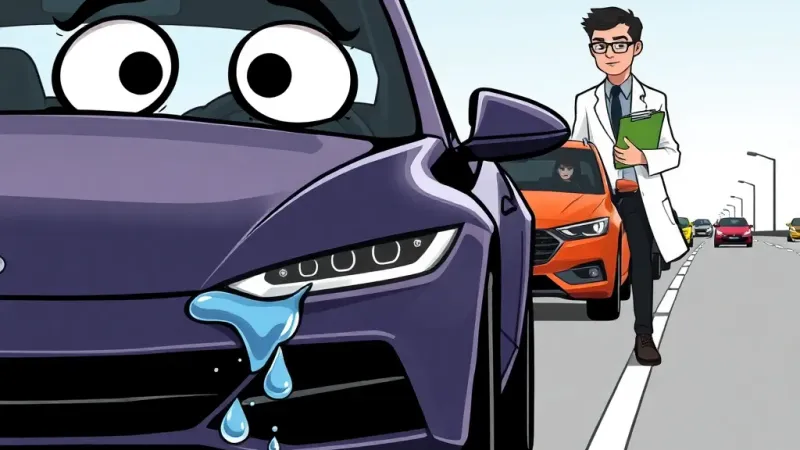
A groundbreaking study released today by the Institute for Applied Sociological Optics (IASO) has officially concluded that the recent surge in popularity of "cute cartoon eye" car headrest covers is not, as previously assumed, simply a matter of whimsical personal expression, but rather a profound coping mechanism for the widespread, unacknowledged loneliness experienced by modern commuters. The report, titled "Gaze Aversion and Projected Playfulness: The Headrest as a Crying Wall," found a direct correlation between the purchase of these anthropomorphic seat accessories and self-reported feelings of isolation during daily drives.
According to IASO lead researcher Dr. Evelyn Marsh, who presented the findings at the annual Conference on Automotive Affective Displacement, the "eyes" on the back of the seats serve as a silent, non-judgmental companion for drivers navigating increasingly depersonalized urban landscapes. "Our data indicates that 82% of individuals who installed these covers reported a statistically significant decrease in road rage incidents, along with a 45% increase in 'unprompted, muttered conversations' with their inanimate car parts," Dr. Marsh explained. "It's a bizarre, yet highly effective, form of self-soothing, transforming the silent, judgmental void behind them into a comforting, if equally silent, witness." The study tracked 3,000 drivers across four major metropolitan areas, analyzing driving habits, physiological stress indicators, and post-commute mood questionnaires.
Industry insiders, however, were less surprised by the findings. "Look, we’ve known for years that people are buying these things because they just want something, anything, to look back at them besides the void," admitted Chad 'The Car Guy' Peterson, Head of Market Engagement for 'AutoGiggles,' a leading distributor of automotive novelty items. "Our focus groups consistently showed that while 'fun' was the stated reason, the underlying sentiment was 'please don't let me be alone in this metal box.' The cartoon eyes are simply a more palatable, mass-marketable way to address that existential dread than, say, a therapy animal that can actually chew through your seatbelts." Peterson noted a particular spike in sales during election years and global crises.
The report suggests a potential future where automotive manufacturers might integrate "emotional support aesthetics" directly into vehicle design, with personalized AI-powered eye patterns that can react to the driver's mood. Early prototypes include "Concerned Eyebrows" for heavy traffic, "Sleepy Lids" for early morning commutes, and "Wide-Eyed Fascination" for scenic routes. Critics argue that this trend merely paper over deeper societal issues of isolation and lack of community, replacing genuine human connection with performative inanimate companionship. One widely shared social media post simply read, "My car has more friends than I do now. Awesome."
Researchers are now investigating whether fuzzy dice fulfill a similar, yet perhaps more primitive, need for companionship.