


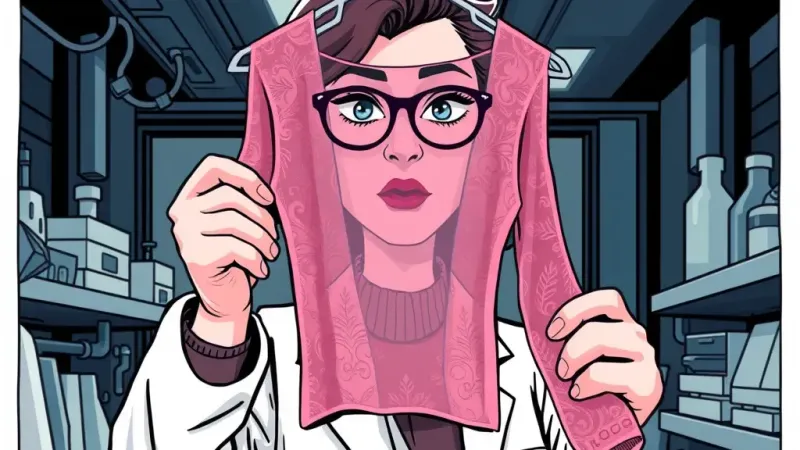
A groundbreaking review of global apparel manufacturing published this week has finally confirmed what millions of freezing women have suspected for decades: female knitwear is not actually clothes, but rather a lightweight, decorative mental health challenge.
While men’s winter garments are routinely engineered with the structural integrity of a medieval siege engine, featuring dense, multi-ply wool, reinforced elbows, and pockets deep enough to shelter a family of four, the women’s section of any retail store operates under entirely different physical laws. According to data compiled from viral social media demonstrations comparing identical clothing categories, a standard-issue men’s crewneck sweater is heavy enough to double as weighted therapy equipment during a panic attack, whereas a women’s cardigan is composed of roughly six yards of translucent cotton-poly blend designed to actively siphon heat away from the human body and vent it directly into the atmosphere.
'When we design men’s apparel, our primary objective is survivability,' explained Marcus Vance, senior vice president of fabric architecture at a major global conglomerate. 'If a man goes outside in a February blizzard wearing one of our fisherman's sweaters, he is essentially encased in fleece-lined armor. He could wrestle a grizzly bear and survive a three-day maritime disaster. But when we look at the women’s market, our research indicated an overwhelming consumer demand for hypothermia-adjacent aesthetics. Women don’t want to trap heat. They want to look like they are ghost-hunting in a haunted Victorian manor while gently shivering for artistic purposes.'
The investigation also highlighted the ongoing mystery of the decorative pocket, a cruel textile prank wherein women’s garments feature the visual promise of storage space, which abruptly terminates half an inch down in a stitched-shut faux-cavity. Men’s sweaters, by contrast, possess cavernous industrial holding bays capable of storing a hardcover novel, an external hard drive, three loose screwdrivers, and a mid-sized burrito without altering the silhouette of the garment in the slightest.
Industry insiders defended the disparity as a triumph of economic efficiency and modern aerodynamic design. By refusing to include functional fabric, heavy weaves, or actual buttons that require opposable thumbs to operate, manufacturers save billions of dollars in raw materials while ensuring that female consumers maintain a sleek, streamlined profile that cuts through heavy winter winds like a knife—primarily because they are already halfway to becoming an ice sculpture anyway.
'Look, if we gave women thick, durable wool sweaters with actual pockets, what happens to the handbag industry?' asked retail analyst Brenda Sterling, noting the delicate ecosystem of late-stage capitalism. 'If a woman can comfortably carry her keys and a tube of lip balm in her own apparel, the entire luxury purse economy collapses within forty-eight hours. We simply cannot allow pockets to undermine global GDP. Frostbite is a small price to pay for shareholder value.'
Furthermore, market researchers noted that the fragile construction of women's knitwear serves a vital role in the fast-fashion subscription model. Because standard women’s sweaters begin to unravel, pill, and dissolve into subatomic dust after precisely three trips through a gentle washing cycle, consumers are forced to return to the mall four times a season just to maintain a baseline level of public decency. Men, on the other hand, are cursed with durable heritage sweaters passed down from their grandfathers that refuse to die, rendering them economically useless to the textile sector for decades at a time.
Ultimately, fashion executives praised the viral videos exposing the gap in knitwear quality as a masterclass in consumer education, reminding the public that looking effortlessly chic should always require a quiet, constant internal battle against the laws of thermodynamics.