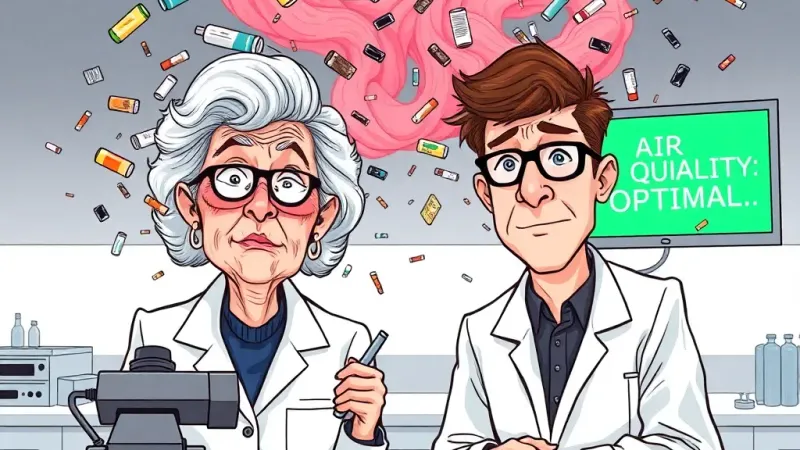
UTRECHT, NETHERLANDS — A groundbreaking new study published today confirms what many have long suspected: the Earth’s atmosphere now consists primarily of an aerosolized cocktail of every manufactured product, industrial emission, and cosmetic spray ever released into it. Researchers at Utrecht University and the University of Un-named-But-Still-Important were reportedly "mildly surprised" to discover that methylsiloxanes, a common class of silicones, are now present in such unexpectedly high concentrations that scientists are considering reclassifying atmospheric air as a "lightly-pressurized consumer waste byproduct."
The study, which meticulously tracked the ubiquitous presence of methylsiloxanes—found in everything from industrial lubricants and automobile components to shampoo, deodorants, and waterproofing sprays—across diverse global environments, noted that concentrations were "significantly higher than predicted by models that assumed humans would eventually stop dumping everything into the sky." According to Dr. Brenda Carmichael, lead atmospheric chemist for the project, "It turns out that when you spray enough 'new car smell' air freshener or use enough anti-frizz serum, it doesn’t just vanish. It actually… stays. And now it’s everywhere. It’s a humbling discovery, really, to find out the sky is just a giant, invisible lint trap for civilization."
Industry groups were quick to respond, mostly by issuing press releases congratulating themselves on their innovative product design. "Our commitment to delivering highly effective, affordable, and, frankly, incredibly fun-to-use silicone-based products has clearly paid off," stated Byron Finch, Vice President of Sustainable Innovation for Global Chemical Conglomerate Omnipolymers Inc. "While we acknowledge the scientific community’s findings regarding 'atmospheric saturation,' we remain confident that future generations will appreciate the silky-smooth feel of their air, even if it occasionally requires a clarifying shampoo." Finch suggested that any concerns about potential health or climate impacts would be diligently addressed by establishing a new inter-industry task force dedicated to funding future studies.
Environmental advocates, meanwhile, have called for immediate action, though conceded they were unsure what action, precisely, could be taken short of telling everyone to just stop using everything. "We’re beyond the point of 'reduce, reuse, recycle,'" commented Maya Singh, director of the Airborne Aesthetics Initiative. "At this stage, we might need a global air filtration system that looks suspiciously like a giant Dyson fan, or perhaps a collective agreement to simply breathe less deeply. Or maybe we just need a better term for ‘air,’ something that more accurately reflects its current composition, like 'processed atmospheric blend #3.'"
The study concluded by recommending further research into why anyone thought this wouldn't happen, and whether future generations would develop gills or simply evolve to run on ambient silicone particulate matter.