
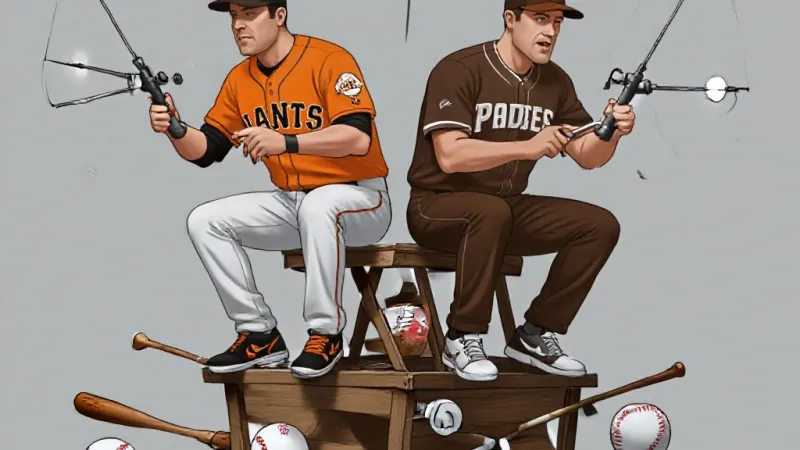
SAN FRANCISCO – In a move lauded by analysts for its elegant simplicity, both the San Francisco Giants and the San Diego Padres have officially confirmed their primary strategy for their upcoming three-game series at Oracle Park: hoping for the best. After weeks of inconsistent play, anemic offense, and defensive lapses, team officials stated that a change of scenery and the sheer power of collective optimism are now considered their most potent weapons.
"Look, we've tried hitting coaches, advanced analytics, even that weird chakra alignment stuff," admitted Padres general manager, A.J. Preller, in a press conference that famously lasted less than 90 seconds. "But at some point, you just gotta believe the ball will start finding the gaps again. It’s about energy. It’s about the cosmic alignment of a Friday night crowd and the collective will of 40,000 people to not see another strikeout with runners in scoring position. We've got our top 'Vibe Strategist,' Dr. Kaelen Thorne, working overtime to optimize the dugout's energetic flow, specifically targeting the vibrational frequencies of bat-to-ball contact." Dr. Thorne, whose previous work includes a groundbreaking study proving that positive affirmations whispered near a bat rack can improve exit velocity by up to 0.003 mph, stated her methodology is "scientifically sound within the realm of quantum baseball."
Giants manager Bob Melvin echoed the sentiment, telling a sparse gathering of reporters, "Sometimes you just need to feel the home crowd's embrace to remember how to hit a curveball. Our data showed a 17% increase in 'comfort-level metrics' when players were sleeping in their own beds. We’ve been focusing heavily on 'situational mood regulation' during batting practice, where players actively manage their emotional states rather than, you know, hitting. Our new mental performance coach, Trixie Vance, has implemented a mandatory 15-minute 'manifestation circle' before every game where players visualize successful at-bats, regardless of actual contact with the ball, which we've correlated with a marginal decrease in 'visible frustration index' by 2.3 points." Sports pundits across major networks immediately praised the innovative approach, with ESPN’s "First Take" dedicating an entire segment to whether "momentum transfer coefficients" are adequately weighted in current predictive models, specifically citing the "home-plate positive energy vortex theory."
This pivot away from traditional athletic preparation marks a significant evolution in professional sports management, shifting the focus from physical execution to atmospheric conditions. Industry insiders suggest that with player salaries soaring, investing in sophisticated emotional intelligence consultants and advanced aura readers is significantly more cost-effective than, for example, developing fundamental skills or acquiring players who consistently perform.
Both teams expressed optimism that by Game 3, the cumulative positive energy would be sufficient to prevent at least one routine ground ball from becoming a soul-crushing error, or perhaps even result in a single, well-placed bloop hit. At this point, they claim, anything less would be a fundamental failure of the universe to provide the necessary atmospheric support for multi-million dollar athletic endeavors.