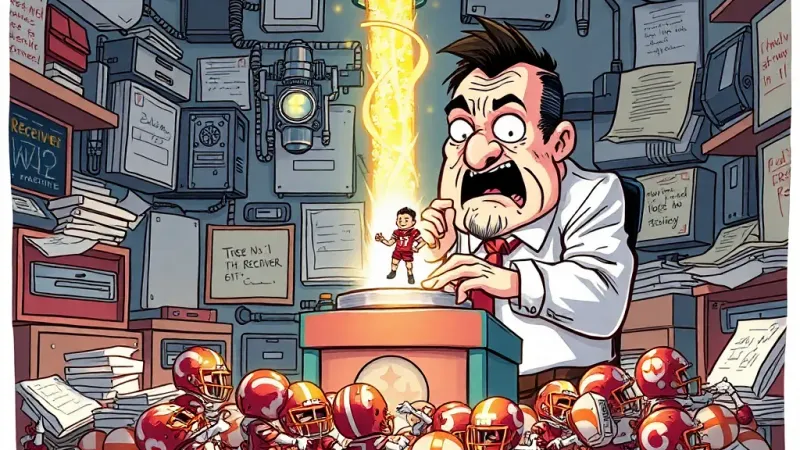
PITTSBURGH, PA — With the 2025 NFL season still months away and the 2026 NFL Draft two years out, the Pittsburgh Steelers front office has reportedly already commenced extensive scouting to address the team's perceived "modest" wide receiver room, despite having recently acquired All-Pro DK Metcalf.
Sources close to the organization, who spoke on condition of anonymity to avoid preemptive fan outrage, confirm that general manager Omar Khan has deployed scouts to observe high school juniors for potential 2026 eligibility. The move comes after a frustrating 2025 season where, even with Metcalf, analysts consistently lamented the absence of a "true No. 1 receiver"—a perpetually elusive archetype seemingly defined by its absence from the Steelers roster, regardless of personnel.
“It’s a unique challenge,” explained sports analytics pundit Dr. Silas Vance, lead author of the widely cited "Perpetual Deficiency Index for Professional Sports Franchises" report. “Even with a Hall of Fame talent, the discourse immediately shifts to how he’s merely a stopgap. The need for ‘more’ is infinite, particularly when you’re evaluating a draft class that is currently 16 years old. We’re identifying players whose parents haven’t even met yet, just to be safe.” Dr. Vance noted that the ideal prospect would not only be generational but also possess an inherent immunity to future media criticism and the universal human condition of growing older.
Among the names being floated for the top-10 consideration in 2026 are fictional prospects such as Brayden "The Blur" Williams, a six-foot-four tight end from an unnamed high school in rural Ohio who currently excels at intramural dodgeball, and Mateo Rodriguez, a highly touted quarterback from Southern California with a surprisingly good punt return average. Both are described as having the "intangibles" necessary to eventually be deemed "not enough" within 18 months of joining the team.
Insiders suggest the team is also considering drafting a player with no discernible football skills but possessing an extremely marketable personal brand, hoping to distract from the on-field performance until the 2027 draft class can be thoroughly assessed. "We're not just drafting talent; we're drafting future conversations," stated an anonymous scout, polishing a pair of binoculars. "And right now, the conversation is about how much more we need."
Team ownership reportedly views the 2026 Draft as a crucial opportunity to finally reach a level of roster saturation that might, for a fleeting moment, silence the insatiable hunger of sports media and an increasingly speculative fanbase, before the cycle inevitably recommences for the 2027 season.