


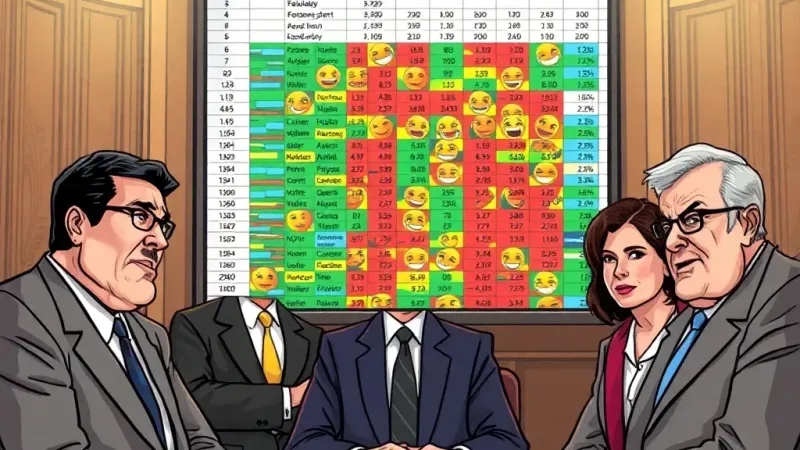
A newly released USA TODAY Sports Coaches Poll has officially assigned Kentucky a spreadsheet number, while Kansas basketball was granted a slightly larger spreadsheet number, marking the first time in recent history that institutional validation has been successfully quantified by men wearing tailored suits and holding laminated playbooks. The ranking system, which operates on the scientific principle that asking exhausted coaches to evaluate teams they barely watch produces objective truth, concluded its annual cycle without technically violating any state laws. Official sources confirmed the final tallies will be printed on heavy cardstock and distributed to alumni donors who expect nothing in return.
Sports poll analysts immediately pivoted to crisis mode, treating the difference between two arbitrary digits like a geopolitical border dispute that could only be resolved through cable news debates and spreadsheet conditional formatting. We knew this was coming, said poll methodology consultant Dr. Aris Thorne, whose peer-reviewed paper on subjective validation currently funds three campus coffee shops. When you place fifty grown men in a conference call and ask them to assign ordinal value to human performance, you inevitably invent a new metric system. It measures nothing, but it demands our complete emotional submission. The committee proceeded accordingly, weighing conference schedules, strength of victory, and how many times a specific coach sighed during halftime, ultimately arriving at a conclusion no different from the one they reached before checking the box. Variance metrics indicate the entire process runs entirely on caffeine and institutional inertia.
The publication cycle responded with predictable theatrical urgency, publishing forty-two breakdown articles within the hour that treated the release date of an internal memo like a lunar eclipse. Broadcast segments featured slow-motion highlights, dramatic telestrator circles around unrelated jersey numbers, and a dedicated graphic that measured institutional prestige in arbitrary units. Network desks deployed correspondents to stand in parking lots and discuss statistical variance with the gravity of a hostage negotiation, ensuring the audience understood that without these numbers, they would be forced to remember why they enjoy sports. Local radio hosts opened their phone lines to accept calls from residents whose entire identities momentarily collapsed upon checking their phones. The entire exercise successfully converted a recreational activity into a mandatory administrative exercise.
The underlying reality, which everyone politely ignores between commercial breaks, is that sports rankings exist solely to fill the silence between actual games, much like corporate mission statements exist to occupy the space between actual work. Yet the machinery turns regardless, processing wins into integers and losses into narrative arcs that somehow make regional pride feel federally sanctioned. The poll does not crown a winner, because the winner was decided months ago, but it does provide a structured way to feel superior to strangers on the internet until 2 season begins. The official report will be archived alongside every other institutional ritual that produces zero outcomes but keeps the lights on.