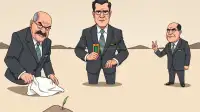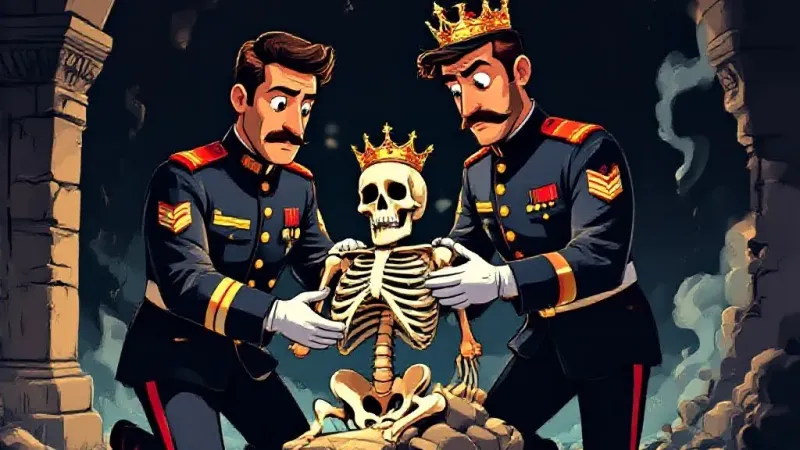
Spanish emergency services successfully extracted the remains of several medieval monarchs from the San Juan de la Peña monastery this week, as a raging wildfire threatened the ancient site. Firefighters, working under extreme conditions and against a backdrop of public property incinerating, prioritized the careful removal of royal skeletal matter, highlighting the nation's unwavering commitment to its most historically significant inert calcium deposits over trivial matters like immediate environmental devastation or modern architectural integrity.
“These aren’t just any bones; these are the foundational calcium-phosphate matrix of our enduring class structure,” stated Dr. Elena Valor, head of the National Institute for Historical Prioritization, in a hastily arranged press conference. “While irreplaceable forests can, theoretically, regenerate and common citizens can, technically, be replaced by new ones, a sovereign’s femur, once lost to the elements, is lost forever. Imagine the administrative nightmare, the bureaucratic void, of trying to prove divine lineage and an unbroken chain of inherited privilege without all the key biological components physically accounted for.” She gestured emphatically with a latex-gloved hand, displaying a small, charred piece of what appeared to be a rib.
The painstaking operation saw heritage specialists meticulously sifting through crypt debris, carefully bagging fragments of skull, femurs, and various phalanges. All this occurred while the monastery's priceless Romanesque architecture and a significant portion of the surrounding ecosystem, including critically endangered wildlife, faced imminent, irreversible destruction. One unnamed firefighter, his face streaked with ash and exhaustion, was overheard muttering, “I literally just hauled a monarch's calcified kneecap out of a burning building while my own house, filled with actual living family photos, is probably catching fire two towns over. This is absolutely peak feudalism, and frankly, I’m not getting paid enough to participate.”
Critics of the rapid, bone-specific response pointed to the relative lack of urgency for, say, saving living local residents, preserving the rare Iberian lynx habitat, or the thousands of irreplaceable manuscripts also threatened by the blaze. However, Dr. Valor dismissed such concerns as sentimental. “The lynx are lovely, of course, and manuscripts are intellectually valuable, but do they represent 1,000 years of unquestioned, hereditary power? I think not. Their survival, while ecologically or culturally relevant in a minor way, simply doesn't send the same clear, visceral message about societal hierarchy that a perfectly preserved royal humerus does. The optics of a complete ancestral royal collection are paramount for national stability.”
With the royal remains now safely relocated to an undisclosed, climate-controlled facility, Spain is breathing a collective sigh of relief, secure in the knowledge that no matter what other societal collapses or ecological disasters may occur, the physical proof of who gets to be important and who doesn't is still intact for future reverence.