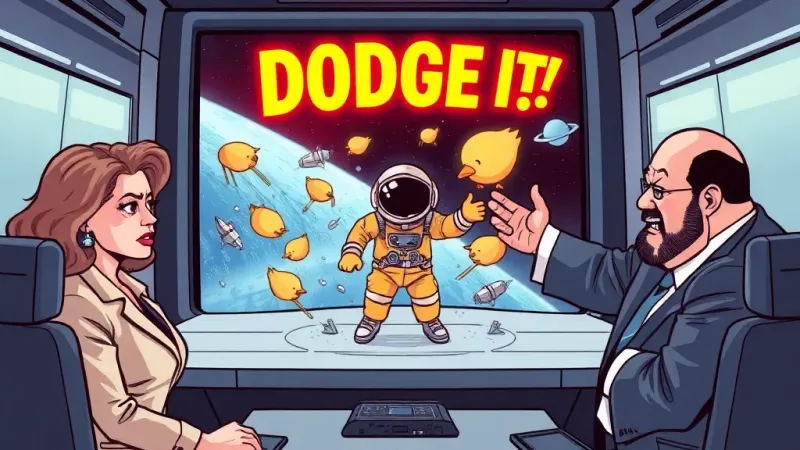
LOW-EARTH ORBIT — Global space agencies have issued a joint advisory to all orbital asset operators, effectively distilling complex astronomical physics into a single, straightforward directive: "just dodge it." The guidance comes after the sun’s recent destruction of the asteroid 2024 BX1, which has generated a significant increase in debris, transforming previously stable orbital paths into what one industry insider described as "the galaxy's largest, slowest pinball machine." This new influx of solar-cooked space rock has forced a re-evaluation of routine orbital procedures, pivoting from predictable trajectories to what officials are calling "dynamic risk navigation."
The new operational paradigm, dubbed 'Proactive Evasive Maneuvering Protocol 7' (PEMP-7), requires all active satellites, defunct rocket stages, and even space tourist capsules to "maintain heightened situational awareness" and "execute immediate corrective vectors" as needed. "We understand that the current orbital environment presents, let's say, 'expanded interaction opportunities' with previously uncatalogued celestial fragments," stated Dr. Aris Thorne, Director of Orbital Resilience for the International Space Traffic Alliance (ISTA). "But frankly, after factoring in all variables, including the prohibitive cost of comprehensive debris removal, we've found that the most efficient solution is simply for operators to manually adjust trajectory. Think of it as defensive driving, but without the benefit of traffic lights or a clear lane."
Industry leaders were quick to embrace the new normal, with several tech firms announcing next-generation "collision avoidance algorithms" designed to "empower autonomous dodging." OmniSpace Solutions, a leading provider of satellite management software, unveiled its new 'Asteroid Alley Navigator Suite,' promising to automate up to 70% of necessary micro-maneuvers. "This isn't a crisis; it's an innovation catalyst," declared OmniSpace CEO Lena Petrova in a quarterly earnings call. "Our models predict a sustained demand for bespoke orbital evasion solutions, particularly from the burgeoning low-orbit internet constellation sector. We're not just selling software; we're selling peace of mind in a dynamically chaotic environment, ensuring uninterrupted cat videos for millions globally."
The financial implications of PEMP-7 are already being felt. Satellite operators are reporting increased fuel consumption due to frequent thrust burns, leading to significantly shortened operational lifespans for orbital assets. Insurance premiums for LEO satellites have spiked by an average of 18% in the last fiscal quarter, with underwriters citing the "unpredictable nature of solar-induced micrometeoroid swarms" as the primary driver. "It's simply the cost of doing business in space now," explained Brenda Hayes, a senior analyst at Orbital Risk Management Group, a firm that recently launched a new 'Debris Futures' trading desk. "We’re hedging against cosmic randomness, and for a modest fee, so can you."
Meanwhile, NASA's astronaut training regimen has reportedly added a new module titled "Don't Think About It: The Zen of Debris Mitigation," focusing on maintaining composure during spontaneous trajectory changes. A recent internal memo from the European Space Agency reportedly advised mission planners to consider adding "1.5x trajectory buffer" to all planned maneuvers, just to be safe.
"Ultimately," Dr. Thorne concluded, "if you want to keep your multi-million dollar asset functional, we recommend developing a very, very good reflex."