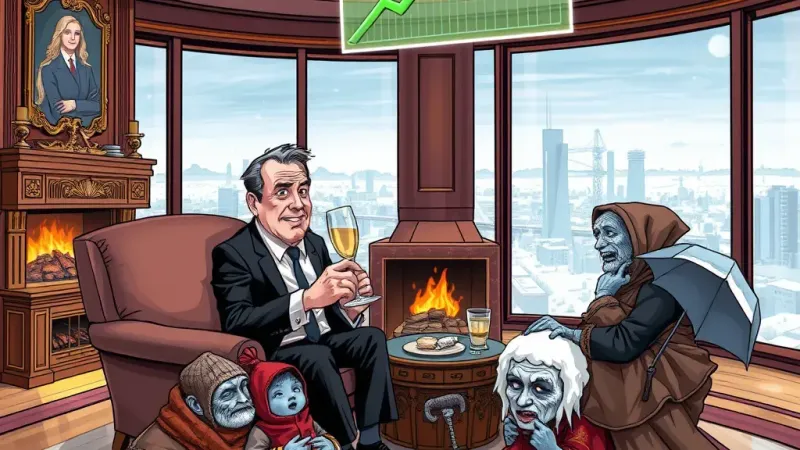
Nationwide energy providers announced Monday that surviving the upcoming winter months will feature a modest, industry-standard pricing adjustment of just seven percent, giving millions of American families the exciting opportunity to choose between maintaining indoor room temperatures above freezing or continuing their reckless, lavish habits of eating three meals a day.
The new pricing projections, released by energy sector analysts who are currently drafting acceptance speeches for record-breaking quarterly bonuses, confirm that households relying on heating oil will experience a slightly more robust adjustment of up to seventy percent. Industry experts have rushed to reassure the public that this massive surge is not a predatory cash grab, but rather a vital market-driven incentive designed to encourage citizens to finally embrace the cardiovascular benefits of mild hypothermia.
"Look, nobody loves gouging the desperate quite like a regulated monopoly, but we have to look at the broader macroeconomic picture," explained Consolidated Power CEO Richard Vance while adjusting the diamond cufflinks he purchased with last year’s polar vortex windfall. "When families look at their thermostats this January and feel a sudden, terrifying drop in ambient temperature accompanied by the unmistakable sound of their own teeth chattering, they aren't experiencing an affordability crisis. They are experiencing the pure, unfiltered beauty of free-market capitalism wrapping its icy, unyielding fingers around their throats. And frankly, they should be thanking us for the workout."
In response to the mounting public panic—characterized by ungrateful homeowners whining about impending evictions and utility shutoffs—Washington lawmakers have stepped up with their trademark decisive action. Congressional leaders from both sides of the aisle convened an emergency closed-door listening session, where they listened very carefully to the lobbying budgets of natural gas conglomerates before emerging to issue a bold, comprehensive legislative strategy: telling everyone to buy an extra sweater.
"We hear the American people loud and clear," announced Senator Robert Thorne during a televised press conference held inside a climate-controlled room kept at a crisp, tropical seventy-two degrees. "Times are tough, inflation is high, and heating your home has become a luxury item previously reserved for royalty and tech billionaires. That is why Congress is proud to introduce the Keep Moving and Wear Three Parkas Act. By shifting the burden of thermal regulation entirely onto the individual citizen's personal wardrobe, we are empowering families to take control of their own misery. If you freeze to death in your living room, that is a failure of your personal layering strategy, not the energy grid."
Advocates for low-income households had previously petitioned Congress for emergency heating relief funds, completely misunderstanding the fundamental purpose of the federal government, which is to ensure that shareholder dividends are never subjected to the indignity of a flat quarter. Economists pointed out that asking utility companies to cap prices during a cold snap is essentially communism, or worse, bad for stock options. Instead, financial analysts suggest that struggling families adopt modern cost-saving measures, such as burning old family photo albums in the fireplace, or simply lowering their body temperature through sheer willpower until they require significantly less heat to sustain vital organ function.
Furthermore, the seventy percent spike for heating oil consumers has been widely praised by wellness influencers, who have long argued that living in a drafty box of ice is the ultimate biohack for longevity and skin tightening. Several high-profile lifestyle bloggers have already begun posting tutorials on how to effectively meal-prep frozen soup blocks directly on your kitchen counter without the burden of a functioning stove.
As the winter months approach, utility companies remain confident that consumers will adapt to the new economic reality through innovation, grit, and the quiet acceptance of their financial irrelevance. After all, nothing brings a family together quite like huddling around a single, dim incandescent bulb while calculating whether pneumonia is cheaper than natural gas.