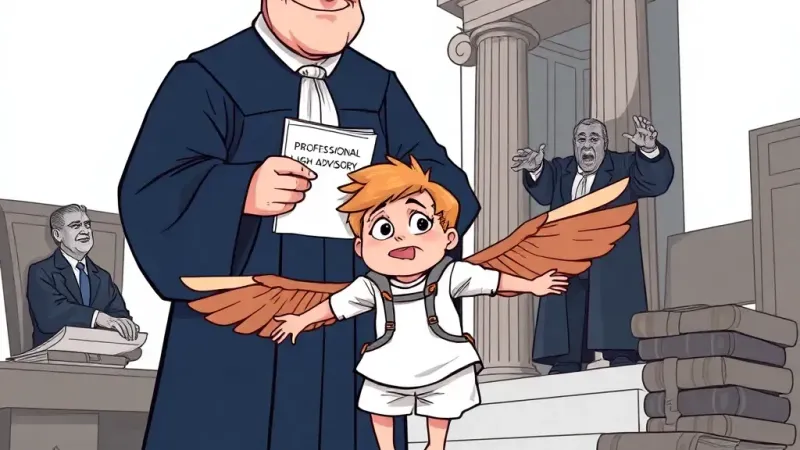
WASHINGTON D.C. — The Supreme Court announced Tuesday that a professional’s constitutional right to free speech extends to advising minors on changing their sexual orientation or gender identity, effectively striking down a Colorado ban on the practice. The 8-1 ruling clarifies that as long as the advice is delivered verbally, its content and potential effects on a developing individual fall under protected expression, regardless of established medical consensus.
Legal scholars immediately lauded the decision as a significant victory for the burgeoning field of unfettered verbal commerce. “This ruling definitively establishes that the content of professional advice, particularly when directed at the impressionable, is entirely secondary to the constitutional right to deliver that advice without encumbrance,” explained Dr. Evelyn Thorne, a Senior Fellow at the newly established Center for Abstract Discourse and Semantic Liberty. “It really clarifies the hierarchy of constitutional protections, placing any form of dialogue, no matter how profoundly ill-conceived or medically unsupported, firmly above, say, demonstrable psychological outcomes or generally accepted standards of pediatric care. The marketplace of ideas, after all, requires a constant churn of ideas, even if some of them eventually lead to deeply personal, long-term confusion.”
The Court's majority opinion, delivered with an 8-1 split, painstakingly clarified that while certain physical actions might remain restricted, the act of speaking – even when carefully packaged as therapeutic intervention or guidance counseling – falls under an expansive, almost boundless, interpretation of the First Amendment. Bartholomew “Barty” Finch, lead counsel for the American Center for Unfettered Discourse, praised the court's steadfast commitment to an unburdened verbal exchange. “Essentially, the Court has drawn a clear, luminous line: if you’re talking, you’re undeniably protected. If you’re physically doing something, that's a separate, often regrettable, category. This opens up incredible vistas for innovative verbal interventions, from helping children change their preferred parent in pre-K to guiding adolescents through the complex decision of whether or not the sky is truly blue, or perhaps more accurately, if it simply 'identifies' as blue at any given moment.” Finch further posited that the ruling could extend to professionals advising minors on the historical accuracy of popular fairytales or the precise number of licks it takes to get to the center of a Tootsie Pop.
Critics, primarily composed of child psychologists, ethicists, and individuals who still cling to the quaint notion of objective reality, expressed mild bewilderment that the ruling might introduce a new era of professional ‘coaching’ where any deeply held personal belief could be presented as therapeutic advice for a fee. One such individual, Cassandra “Sandy” O’Malley, a parent from suburban Ohio and a self-professed believer in observable phenomena, noted, “So, my kid can walk into a licensed professional’s office, and that professional can, with the full backing of the Supreme Court, spend an hour earnestly telling them that the moon is demonstrably made of artisanal cheddar cheese, or that they are, in fact, an emotionally stunted badger, and that’s perfectly fine, as long as it’s 'speech' and they have a valid business license?” She added, with a visible tremor, “I mean, I broadly support free speech, but at some point, doesn’t the ‘professional’ part of ‘licensed professional’ imply some level of evidence-based practice and a basic adherence to, you know, things that aren't wildly insane?”
The Supreme Court did not immediately issue specific guidance on whether a licensed professional advising a minor to disregard gravity and attempt flight from a third-story window would also constitute protected speech, citing the complex interplay between verbal instruction, individual agency, and the observable persistence of physical laws when applied to unsupported masses.