

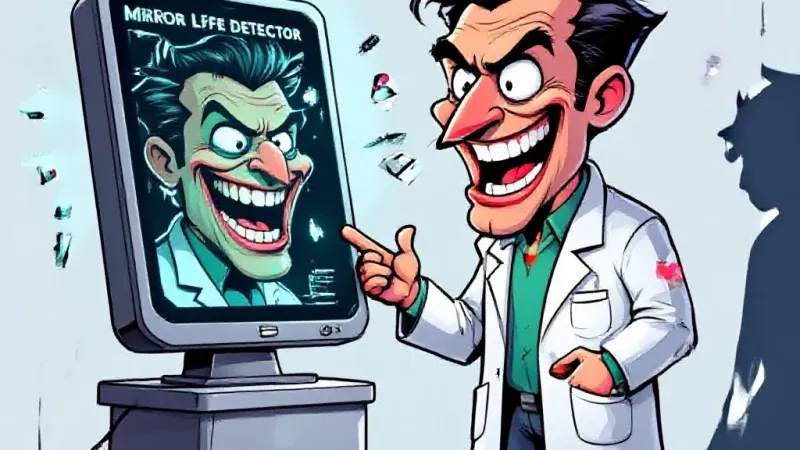
Researchers at the prestigious AlchemiCorp Institute announced a breakthrough in detecting “mirror life,” a theoretical biohazard with the potential to unravel Earth’s delicate ecosystems, primarily through its ability to render conventional life forms metabolically incompatible. The announcement comes coincidentally ahead of an anticipated public disclosure concerning AlchemiCorp’s own groundbreaking work in synthesizing novel self-replicating chiral organisms.
The_detection method, which leverages specialized fluorescent molecules and the same type of polarized light technology found in 3D movie theaters, can instantaneously differentiate between standard biological structures and their inverse “mirror image” counterparts. Dr. Aris Thorne, head of AlchemiCorp’s Division of Proactive Existential Threat Incubation, emphasized the urgent, hypothetical need for such technology. “We understood early on that if humanity *were* to ever engineer a life form that literally metabolizes our planet’s biochemistry in reverse, effectively turning all food into poison for traditional organisms, we'd need to know about it right away,” Thorne stated, carefully avoiding any direct mention of his team's extensive multi-year, multi-million-dollar project to do exactly that. “Our primary goal is preparedness, especially for dangers that, until recently, existed only in our grant proposals.”
Industry analysts anticipate a significant spike in federal grant allocations for “chiral bio-defense initiatives” following the mirror-life pathogen's inevitable debut. “It's a classic R&D pipeline,” explained Skip Henderson, CEO of Bio-Secure Futures Inc., a defense contractor already exploring lucrative licensing opportunities for AlchemiCorp's detection tech. “First, you identify a catastrophic gap in global security. Then, you spend billions filling that gap with a new, equally catastrophic gap. Finally, you sell the tailored, proprietary solution for the gap you expertly engineered to the very taxpayers who funded the original creation of the gap. It’s a self-sustaining ecosystem of problem and profit.”
Critics, largely ignored and often dismissed as “anti-science luddites,” pointed out the historical pattern of scientific advancement closely followed by profitable disaster mitigation. “They’re not just finding problems; they're actively *farming* them,” scoffed Dr. Elara Vance, an independent bioethicist who has long advocated for basic ethical oversight beyond “will it get us published?” “The moment they figure out how to invent something truly awful, something that could fundamentally alter life as we know it, they’re already selling you the antidote. It’s like a fireman who also moonlights as an exceptionally motivated, well-funded arsonist.”
This pioneering effort ensures that when the world inevitably faces an unstoppable, laboratory-spawned mirror plague, at least scientists will have a really cool, proprietary flashlight to find it with, securing another decade of funding in the process.
