
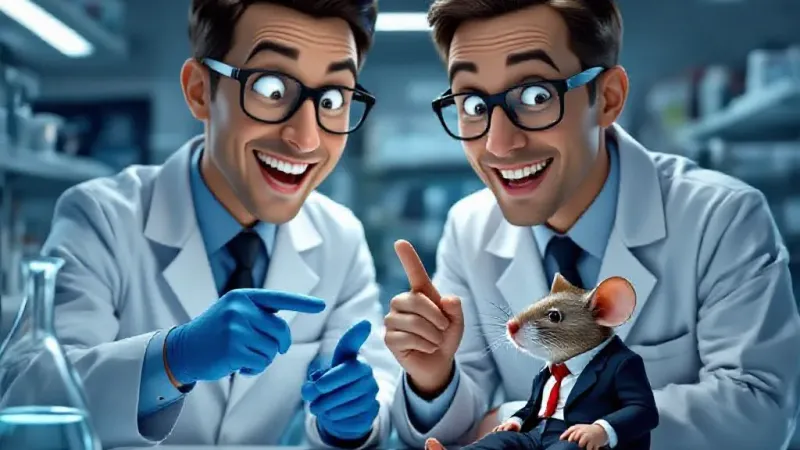
A groundbreaking new study confirms that mice implanted with human brain cells are exhibiting all the classic signs of mild, manageable existential dread, a key achievement for researchers at the Institute for Minimal Moral Impediments. The hybrid rodents, now capable of pondering their fleeting existence and the meaninglessness of their repetitive lab tasks, have not yet crossed the threshold into full human personhood, meaning they still can't sue for emotional distress or demand a 401k match.
"We're calling this the 'Goldilocks Zone' of suffering," explained Dr. Evelyn Finch, lead neuro-ethicist (and part-time compliance officer) for Project Chimera. "They're just intelligent enough to experience profound cosmic despair while staring blankly at a pellet dispenser, but not so intelligent that they'd, say, unionize or write a scathing op-ed for *The New York Times*. It’s a delicate balance, and frankly, a huge relief for our legal department, who were worried about the implications of fully sentient, legally recognized lab subjects."
The new models are expected to revolutionize neurological disorder research, particularly for conditions like chronic ennui, the crushing weight of modern life, and the vague, persistent feeling that you've forgotten something important. Pharmaceutical companies are already lining up to test new antidepressants and anti-anxiety medications on subjects who genuinely understand why they need them, rather than just exhibiting generalized rodent anxiety. "It's a game-changer for market validation," stated a major pharma executive, speaking on condition of anonymity due to ongoing class-action lawsuits concerning *human* trials. "These mice get it. They *really* get it."
Critics, mostly from the fringe "animal rights" community and "people who read too much philosophy," raised minor concerns about the ethics of creating conscious beings solely for suffering. However, the research team quickly pointed out that the mice have not demonstrated any understanding of complex economic theory, the housing crisis, or the subtle nuances of online dating, thus definitively proving they lack the full cognitive capacity to be considered anything more than advanced lab equipment. "They're not *people*," emphasized Dr. Finch. "They just experience human-level loneliness and the gnawing awareness of their own mortality. Totally different."
The Institute plans to scale up production, ensuring a steady supply of these uniquely miserable yet compliant test subjects. Their ultimate goal: to develop a mouse model so exquisitely aware of its own Sisyphean existence that it could accurately review prestige television dramas, provide insightful commentary on the latest TikTok trends, but still reliably perform maze tasks and accept minimum wage for their suffering. Researchers are currently exploring gene editing to ensure the mice can also develop a healthy dose of imposter syndrome.