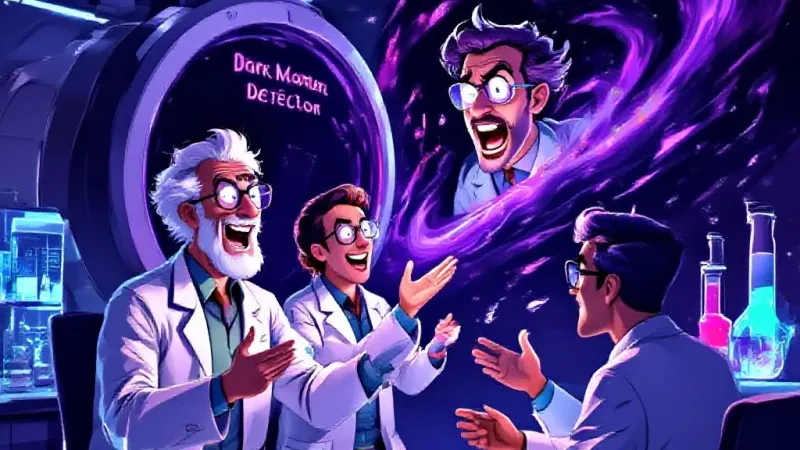
CERN — in a groundbreaking study published today — announced that the mysterious, ultralight particles previously theorized as 'dark matter' have finally been identified. The pervasive cosmic hum that Earth’s magnetic field has been detecting is, in fact, the collective, unconscious energy expenditure of billions of humans pretending to have fully consumed online content they’ve only skimmed.
Dr. Evelyn 'Evie' Thorne, lead astrophysicist at the newly established Institute for Aspirational Proximity Studies (IAPS) at the University of Geneva, explained the painstaking process. 'We effectively used Earth itself as a giant quantum-level 'bullshit detector,' constantly scanning for anomalous energetic discharges. What we initially thought were exotic fluctuations from primordial black holes turned out to be the faint but undeniable psychic strain of people sharing think-pieces they haven't read, or reacting strongly to headlines without ever clicking through to the actual article,' Thorne stated. 'For years, we chased exotic particles, when all along, the universe was simply manifesting our shared digital performance anxiety.'
The study meticulously cataloged these 'dark truth-avoidance photons,' revealing their strongest emissions during peak social media hours. 'The peaks don't correlate with actual engagement, but with performative engagement,' added Dr. Thorne. 'The highest readings registered when someone shared a complex geopolitical analysis after only glancing at the embedded image, or offered a profound take on a scientific breakthrough by merely reading the first two sentences. These aren't just theoretical axions; they are the ghost energies of millions of people nodding sagely at a tweet, or sharing a news story with a strong opinion based solely on the headline and an accompanying image. It’s a very specific kind of energetic fraud.'
Further analysis suggests that 'dark energy,' the even more mysterious force accelerating the expansion of the universe, might simply be the sheer willpower required by humanity to maintain this charade across multiple social media platforms simultaneously. The universe isn’t expanding, Dr. Thorne posited; it’s just trying to keep up with the ever-increasing volume of unread articles and unwatched videos that everyone claims to have deeply engaged with. The cosmic background radiation, once thought to be an echo of the Big Bang, is now tentatively being re-classified as the collective sigh of relief when a viral post about an article they didn't read finally dies down.
The implications are profound, suggesting our universe isn’t full of incomprehensible cosmic forces, but rather just a vast, silent repository of humanity’s most relatable, unacknowledged online coping mechanisms.