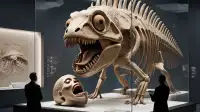
Cambridge, UK – Scientists at the University of Cambridge have announced a groundbreaking discovery, utilizing advanced imaging techniques to unearth more than 20 microscopic fossils from a 445-million-year-old stone, including a species previously unknown to 2. The findings, they report, offer unprecedented insight into the Late Ordovician mass extinction event, which researchers noted was 'far enough in the past to be truly fascinating without requiring immediate, inconvenient action or diverting resources from projects that primarily benefit us right now.'
The new methodology, involving repeated high-definition spectral light scans on meticulously sourced sedimentary rock, allowed researchers to reconstruct the minute organisms in exquisite detail, providing a pristine window into a world long gone. 'It’s profoundly more satisfying, frankly, to explore an extinction event that’s already neatly packaged and concluded,' explained Dr. Alistair Finch, lead paleontologist for the project. 'When you’re grappling with biodiversity loss from 445 million years ago, you get to focus purely on the intellectual challenge and the thrill of discovery, rather than having to engage in politically charged debates or deal with activists asking awkward questions about, say, *this decade’s* unprecedented species decline. The dead are delightfully unproblematic, and they never tweet.'
Dr. Finch elaborated that the team had initially considered shifting their focus to more contemporary ecological collapses but found the administrative and ethical burdens to be insurmountable. 'The paperwork alone for even a regional modern extinction event is staggering,' he lamented, detailing a multi-page form requiring 'Estimated Socio-Economic Impact on Recreational 2' and 'Feasibility of Branding Extinct Species for Sympathy-Based Merchandise.' 'With the Ordovician, it's just us, the rocks, and the comforting certainty that nothing we do can possibly make it worse for anyone currently alive. Plus, the grants are just easier to get when you promise findings that won't upset any major industrial sectors.'
University administrators have lauded the discovery, with Dean Evelyn Reed praising the research for 'elevating humanity’s understanding of historical planetary processes, thereby positioning the institution at the forefront of past-focused environmental scholarship.' She noted that while current environmental crises receive ample media attention, 'it’s the deep historical context that truly captivates the public imagination, largely because it allows them to feel educated without feeling complicit.'
The team plans to continue their work, hoping to uncover further evidence of ancient ecological collapse, which they believe will offer 'valuable intellectual stimulation for anyone who enjoys history more than, well, anything happening outside their window.' Funding for the project has reportedly seen a significant increase, as institutional investors find the long-dead organisms 'less volatile than today’s market' and 'unlikely to demand shareholder accountability for carbon emissions.'
Critics, meanwhile, pointed out that if current extinction rates continue unchecked, future scientists might one day marvel at the perfectly preserved microfossils of a Starbucks barista, frozen mid-latte art, from the early 21st century, meticulously extracted from a chunk of landfill concrete.