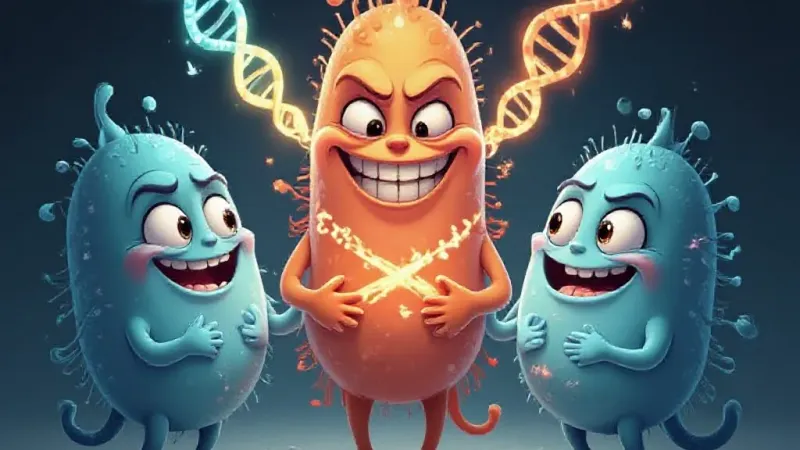
Geneva, Switzerland – Scientists at the University of Geneva have confirmed what every other single-celled organism in the petri dish suspected: that one ciliate got its uncanny sense of direction from an "unusual three-way" genetic exchange. The scandalous bacterial hookup, which involved a clandestine transfer of magnetic orientation genes from one bacterium to another, then finally to the ciliate, has reportedly bestowed upon the tiny eukaryote an unearned advantage in navigating optimal living conditions. Less 'adventurous' microbes are left directionless and seething, reportedly circling aimlessly in nutrient-poor corners of the slide, still waiting for their own organically acquired sense of purpose.
“It’s just not fair,” lamented a nearby amoeba, who preferred to remain anonymous to avoid cellular backlash. “Some of us spend eons evolving, meticulously adapting to our surroundings, painstakingly building our own internal compasses. Then *poof*, one little party with a couple of bacteria and suddenly you’re a GPS-enabled superstar, finding all the best nutrients and avoiding all the toxic sludge. Where’s the equity in that? My organelles are practically vibrating with outrage, but nobody cares unless you’re magnetically aligned.”
Dr. Myra Piffle, Director of the Institute for Opportunistic Symbiosis Studies, defended the ciliate’s actions, noting, “Evolution isn’t always pretty. Sometimes, getting ahead means being open to… novel partnerships. This ciliate simply diversified its genetic portfolio. Others should take notes instead of moralizing from their nutrient-poor corners of the slide. It’s a bold move, strategically speaking, and frankly, quite efficient.” The Institute’s latest study, funded by an undisclosed venture capitalist whose primary investment is in "disruptive biology," suggests a direct correlation between genetic promiscuity and accelerated resource acquisition.
The incident has sent ripples through the microscopic community, sparking widespread debate about genetic integrity versus sheer survival. Some factions are calling for stricter “cellular conduct” guidelines and mandatory "magnetic divestment," fearing a complete breakdown of traditional evolutionary pathways. Meanwhile, others, primarily other ciliate species and several ambitious paramecia, have reportedly begun actively seeking out their own “unusual three-ways” in a desperate attempt to catch up. Whispers of a new “magneto-influencer” economy are already spreading, as once-obscure organisms with magnetic senses suddenly find themselves at the top of the food chain, effortlessly navigating towards prime real estate, exclusive algal blooms, and starring roles in next season’s ‘Microbial Millionaires.’
Professor Alvin Plankton, a respected elder in the protozoan community, expressed concern. "This sets a dangerous precedent. We always taught our flagellates to earn their stripes, to orient themselves through honest phototaxis. Now, it's all about who you know, or rather, who you've had an 'unusual three-way' with. The fabric of our microscopic society is tearing."
The scientific community, meanwhile, continues to study the phenomenon, completely missing the point that if you want to get anywhere in life, sometimes you just have to lower your standards and participate in an “unusual three-way” to download the latest navigation software. After all, nobody cares how you got the compass, just that you found the good stuff first.